Tell Us About Your Project

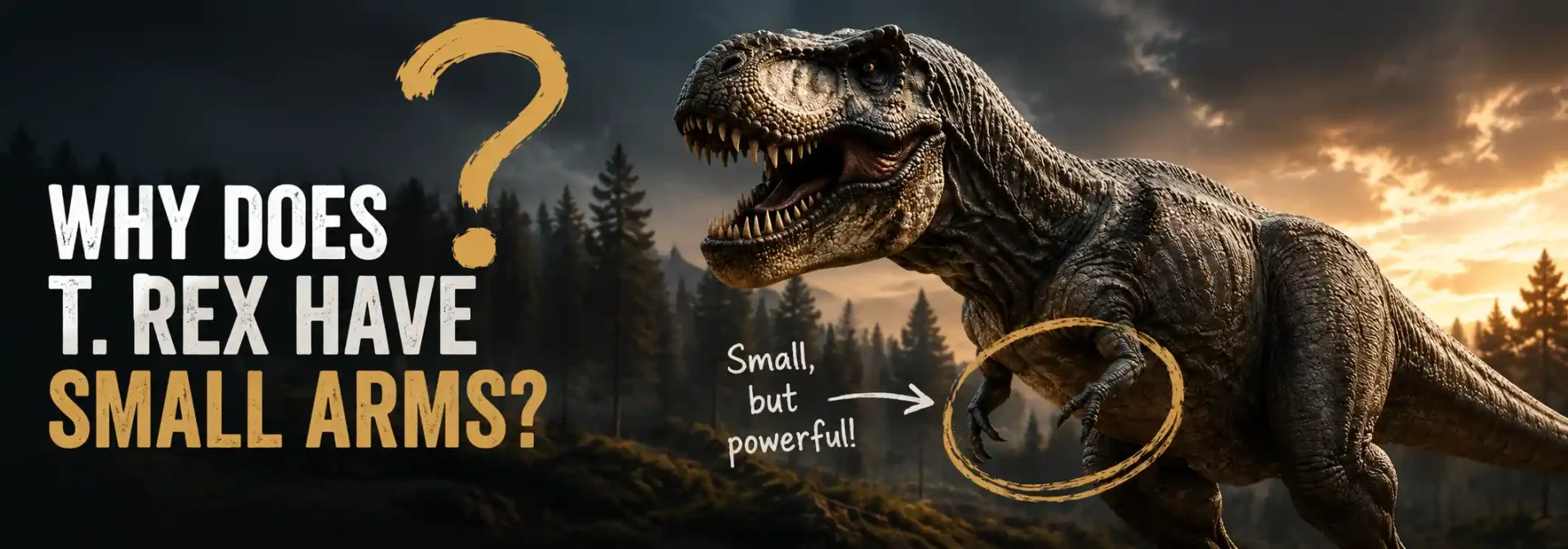
Why Does the T. rex Have Small Arms? Scientists Still Debate the Answer
Few dinosaurs have sparked more questions than Tyrannosaurus rex. And one question has puzzled children, museum visitors, and even scientists for decades: Why does the T. rex have small arms?
No one knows for certain. Scientists have proposed several theories, including evolutionary trade-offs, feeding behavior, and stronger bite-force development, but none has been proven conclusively.
What researchers do agree on is this: the tiny forelimbs were not useless. They were surprisingly powerful, evolved alongside its enormous skull, and ultimately became one of the most recognizable features of the most famous dinosaur ever discovered.
That unusual body shape still influences museums, films, toys—and even modern animatronic dinosaur engineering today.
Quick Answer
If you’re short on time, here’s the bottom line.
Scientists still don’t know the exact evolutionary reason for these tiny proportions. Current evidence supports four widely accepted conclusions:
- Four major scientific theories currently exist regarding its forelimbs.
- The arms were probably much stronger than most people imagine.
- Several other meat-eating dinosaurs evolved the same feature independently.
- Those tiny proportions helped create one of the world’s most recognizable dinosaur silhouettes.
Four Ideas Scientists Are Still Debating
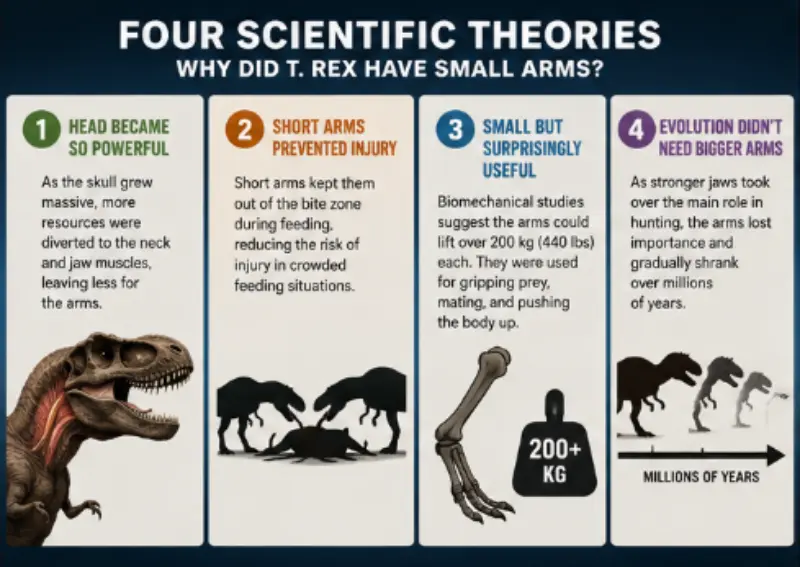
When paleontologists try to figure out the reason behind these short limbs, they usually point to four main possibilities. None are perfect, but together they paint a pretty clear picture. According to recent paleontological research, these tiny arms may have been far more functional than previously thought.
Maybe the Head Became So Powerful That Arms Didn’t Matter
Evolution is all about trade-offs. As the T. rex skull grew massive to deliver bone-crushing bites, the body had to compensate. Some researchers believe biological resources were diverted to neck and jaw muscles, leaving less “budget” for the forelimbs.
Maybe Short Arms Prevented Serious Injuries
A 2011 study suggested that if multiple T. rex individuals fed on a carcass together, long arms would get in the way. Short arms kept them out of the bite zone, preventing accidental amputations during a messy, competitive meal.
Maybe They Were Small—but Still Surprisingly Useful
Don’t let the size fool you. Biomechanical studies estimate those forelimbs could generate forces equivalent to lifting over 200 kilograms (440 lbs) each. They weren’t useless twigs; they were heavily muscled tools likely used to grip struggling prey or hold a mate during reproduction.
Or Maybe Evolution Simply Didn’t Need Bigger Arms
As the ancestors of T. rex evolved stronger jaws to do the killing, the front limbs lost their primary job. Over millions of years, they shrank because they were no longer essential for survival. Understanding the evolution of this unique trait requires looking at this long timeline.
What Most People Get Wrong About T. Rex Arms
There’s a lot of misinformation out there. Here’s what the science actually says:
Myth: The arms were useless. Reality: Biomechanical studies suggest the arms may have been capable of generating forces equivalent to lifting more than 200 kg each. That’s stronger than most adult humans can deadlift. They were functional tools, not evolutionary mistakes.
Myth: They couldn’t move much. Reality: While the range of motion was limited, the tiny T rex arms had powerful muscles for gripping and pulling. The shoulder joint allowed meaningful movement.
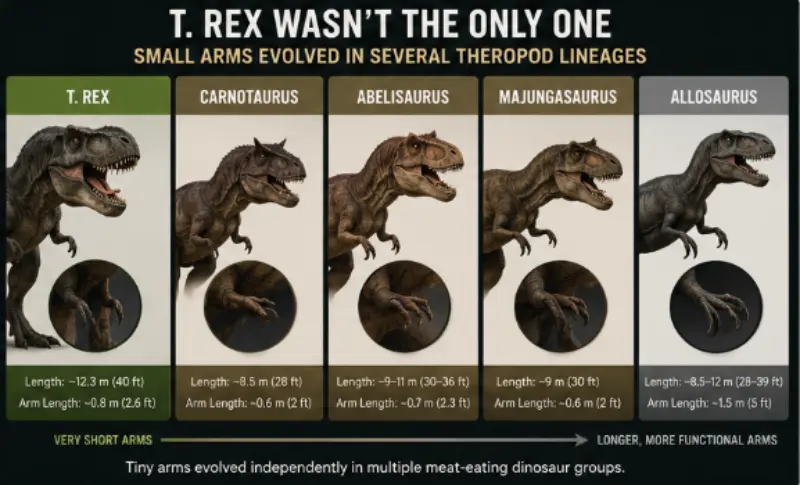
Myth: T. rex was the only one with tiny arms. Reality: Carnotaurus, Abelisaurus, and Majungasaurus all had similarly short forelimbs. It was a successful evolutionary strategy among large theropods.
Myth: They were too short to do anything. Reality: Short doesn’t mean ineffective. The arms were positioned perfectly for gripping prey close to the body or stabilizing during mating.
Were T. Rex Arms Actually Useless?
No. This is a common myth.
While they couldn’t reach their own mouths, those short arms were likely used for gripping prey, mating, and helping the massive animal push itself up from the ground. Some scientists even argue they played a role in balance during sharp turns. This misconception often clouds the real function of T. rex arms. Researchers are still actively studying this today, but “useless” is definitely the wrong word.
T. Rex Wasn’t the Only Dinosaur with Tiny Arms
Here’s a fact that rarely makes it into pop culture: T. rex wasn’t the only one.
Carnotaurus, Abelisaurus, and Majungasaurus all had ridiculously short forelimbs. In some cases, like Carnotaurus, the arms were even smaller and more fused than a T. rex.
This tells us that small arms evolved independently in several meat-eating dinosaur groups. Knowing this evolutionary context is key to understanding the unique proportions of its arms compared to its distant ancestors.
Why Tiny Arms Made T. Rex Even More Memorable
From a visitor psychology standpoint, those tiny forelimbs are a gift.
There are hundreds of dinosaur species. But when you show a kid a silhouette with a massive head, huge teeth, and two comically small arms, they instantly know what it is.
It’s a visual symbol. Thanks to Jurassic Park, toys, and video games, that specific proportion is burned into the global consciousness. This visual impact is a huge part of why T. rex arms are so iconic in pop culture. It’s not just a dinosaur; it’s an icon.
Why Theme Parks Almost Always Choose T. Rex First
In our experience, nearly every commercial dinosaur attraction project starts with one request: “We need a T. rex.”
That’s true whether the customer is building a museum exhibit, a family entertainment center, or a temporary dinosaur exhibition. Visitors simply expect to see one.
| Factor | T. Rex | Other Dinosaurs |
|---|---|---|
| Visitor recognition | ★★★★★ | ★★★ |
| Photo appeal | ★★★★★ | ★★★ |
| Movie familiarity | ★★★★★ | ★★ |
| Merchandise potential | ★★★★★ | ★★★ |
| Family attraction | ★★★★★ | ★★★ |
A theme park dinosaur needs to draw crowds, and the animatronic T. rex does that effortlessly. However, if you are looking to build a diverse exhibition, it helps to understand the broader landscape of the most popular dinosaurs for theme parks and how they complement a T. rex.
Surprisingly, Tiny Arms Also Simplify Animatronic Engineering
Here’s where the science meets the factory floor.
Paleontology explains why T. rex looked this way. Engineering determines how we recreate it.
Compared to long-armed dinosaurs like a Velociraptor or Brachiosaurus, a T. rex requires fewer synchronized joints in the front body.
On large animatronics, every additional moving joint increases weight, wiring complexity, waterproofing requirements, maintenance time, and motor synchronization. That’s why fewer forelimb movements can actually improve long-term reliability.
In practice, the head alone often contains more moving components than both forelimbs combined.
But let’s be clear: a T. rex isn’t necessarily cheaper to build. The real engineering headache is the massive head, the complex jaw mechanism, the counter-balancing, and the realistic skin movement. We spend less time on the forelimbs and more time making sure that jaw snap looks terrifyingly real.
Ironically, the smallest part of the dinosaur is rarely what determines the complexity of the project.
What If T. Rex Had Long Arms?
Imagine replacing those tiny T. rex arms with Velociraptor-sized forelimbs.
Oddly enough, most people would immediately feel something was wrong.
That’s because our brains recognize a T. rex by proportions—not by size alone. The oversized skull, powerful tail, and tiny forelimbs together create one of the most iconic animal silhouettes in history. Changing that ratio breaks the illusion.
From Fossil to Animatronic: How We Recreate an Animatronic T. rex
When designing an animatronic T. rex—or any creature in our extensive animatronics catalog—we constantly analyze these proportions from a visitor’s perspective.
We never artificially enlarge the arms to make them look “cooler.” Visitors expect the tiny arms; making them bigger would actually make the model look fake. Instead, we focus on the shoulder joint’s range of motion and how the arm muscles tense up when the head moves.
In our experience, visitors don’t stare at the arms waving around. They look at the overall posture, the eye movement, and the bite. The tiny arms just complete the iconic silhouette of this ultimate theme park dinosaur.
Key Takeaways
- Scientists still debate why T. rex evolved tiny arms.
- The arms were small, but probably far from useless.
- Several carnivorous dinosaurs evolved the same feature independently.
- Tiny arms became one of the defining features of the world’s most recognizable dinosaur.
- For theme parks and museums, that instantly recognizable silhouette is part of what makes T. rex such a powerful attraction.
Frequently Asked Questions
Why does the T. rex have small arms?
Scientists still debate this, but current evidence points to evolutionary trade-offs favoring a massive skull and powerful bite over large forelimbs.
Did T. Rex use its arms?
Yes. Evidence suggests its arms were used for gripping prey, mating, and pushing the body up from the ground.
How strong were T. Rex arms?
Very strong. Biomechanical studies suggest the arms may have been capable of generating forces equivalent to lifting more than 200 kg (440 lbs).
Could T. rex clap its hands?
No. The elbow and shoulder joints were structured in a way that prevented the hands from rotating inward to meet each other. They were built for pulling, not clapping.
Could T. Rex touch its mouth with its arms?
No. The arms were too short and faced inward. They couldn’t reach the snout.
Did all carnivorous dinosaurs have short arms?
No. Theropods like Allosaurus and Velociraptor had proportionally longer, more functional arms.
The Real Reason People Keep Asking This Question
Scientists may eventually discover the definitive reason behind these unique proportions.
But perhaps the better question is why we still care.
The answer is simple. Very few extinct animals remain instantly recognizable across every culture, every generation, and every continent. The T. rex does.
Its tiny arms may never have made it a better hunter—but they certainly helped make it unforgettable.
Sometimes the smallest detail becomes the biggest reason people remember an animal.
And for museums, theme parks, and commercial dinosaur attractions, being unforgettable is exactly what matters most.
If you’re planning a dinosaur attraction, understanding why visitors remember certain species is often just as important as understanding the science behind them.
Planning a commercial dinosaur attraction?
Editor’s Note: This article blends current paleontological theories with real-world manufacturing experience. Every animatronic T. rex we build balances scientific accuracy with the practical demands of theme park operations, helping us better understand the mechanics of T. rex arms in both nature and engineering.