Tell Us About Your Project

How Did Dinosaurs Communicate If They Couldn’t Speak Like Humans?
Think of Jurassic Park, and you immediately hear that earth-shattering roar. But if you are wondering how did dinosaurs communicate in the real prehistoric world, the reality was probably a lot less dramatic.
They almost certainly communicated—but not through human-like speech. Paleontologists suspect they relied on low-frequency booms, visual displays, body language, and maybe even ground vibrations. We piece most of this together from fossils and living relatives such as birds and crocodiles, which gives us a solid idea of what did dinosaurs sound like.
For those of us building dinosaur attractions, this isn’t just textbook trivia. When we design animatronic dinosaurs, the real challenge is balancing what the fossils actually tell us with what a visitor expects to see.
Quick Answer
If you want the short version: dinosaurs communicated, just not through human-like speech. They relied on a mix of sounds, visual cues, body language, and maybe even vibrations.
Here is what that actually looked like:
- Sounds: Think low-frequency booms, hisses, and honks. And closed-mouth vocalizations. Forget the Hollywood roars.
- Visuals: Colorful feathers, horns, crests, and specific body postures.
- Body Language: How they moved their heads, positioned their tails, or displayed territory.
- Ground Vibrations: The massive sauropods might have actually “felt” each other’s foot stomps through the dirt.
This helps answer what did dinosaurs sound like in reality.
How Scientists Know How Dinosaurs Communicated
Look, we’ve never actually heard a dinosaur. There are no audio recordings from the Cretaceous period, obviously. So how do paleontologists even start to figure this out?
They basically piece it together using three main clues to reconstruct dinosaur communication:
1. Birds (They are literally living dinosaurs) Watch a bird in your backyard. The calls, the mating dances, the territorial posturing—it’s all right there. If modern birds use complex vocalizations and visual signals, it’s a safe bet their ancestors did the exact same thing.
2. Crocodiles (The closest cousins) Then you look at crocodiles. They hiss, they bellow, and they have very specific body postures. Since both birds and crocs communicate this way, their common ancestor (the dinosaurs) almost certainly used similar strategies.
3. The Fossils Themselves Finally, the bones tell a story. Skull structures, weird crest shapes, feather impressions, and even ear anatomy give scientists hard data on what sounds these animals could physically make and how they might have shown off to each other, painting a clearer picture of how dinosaurs communicated.
Four Clues on How Dinosaurs Communicated
1. Sounds—But Not Movie-Style Roars
Instead of movie-style roars, many dinosaurs likely relied on closed-mouth vocalizations—think of the deep boom of an ostrich or the soft coo of a dove.
Keeping the mouth closed lets low-frequency sounds travel massive distances without giving away the animal’s exact location. Some probably hissed or honked. Others might have tapped into infrasound—frequencies so low we can’t hear them, but other dinosaurs could pick them up from miles away.
2. Visual Displays
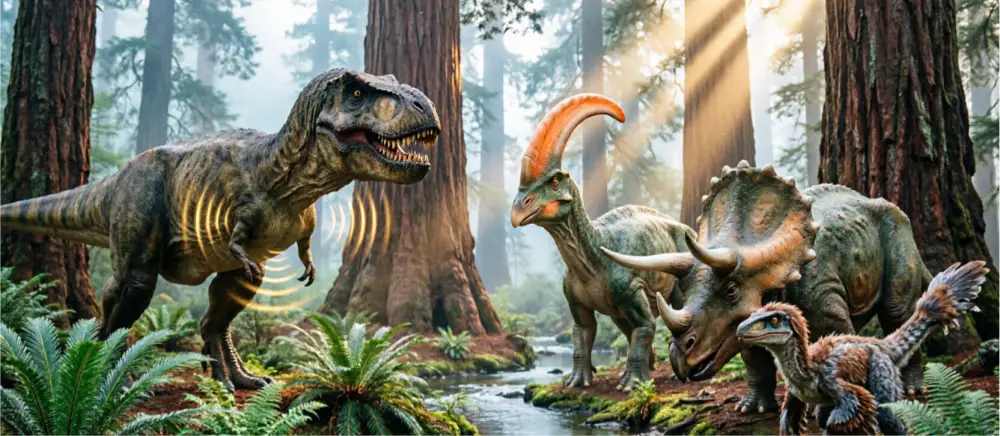
Take feathered dinosaurs like Velociraptor or Microraptor. They likely used their plumage to show off—fluffing up feathers to attract mates or warn off rivals.
Then you have crested dinosaurs like Parasaurolophus, whose head structures could amplify sound while doubling as striking visual signals. And don’t forget horned dinosaurs like Triceratops, using their massive frills and horns to display dominance.
3. Body Language
Every single movement probably meant something. Head position, tail angle, how they oriented their bodies.
A lowered head might mean “back off.” A raised tail could signal alertness. During mating season, specific postures would have been impossible to misinterpret.
4. Ground Vibrations
Here’s a fascinating possibility: giant sauropods might have communicated through the ground.
Imagine an 80-ton Brachiosaurus stomping its foot. The vibration would travel for hundreds of meters. Other sauropods may have been able to detect those signals—essentially “hearing” through the earth.
This suggests some large dinosaurs may have used ground vibrations to communicate, much like modern elephants do.

Did Dinosaurs Roar Like in Jurassic Park?
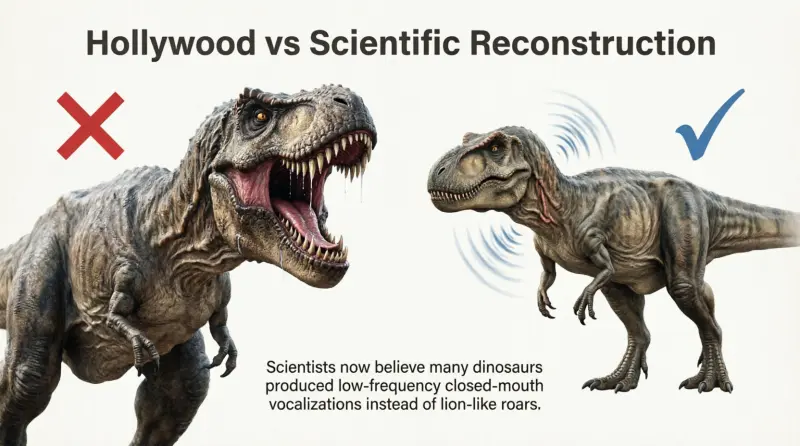
No. The dinosaur sounds we hear in Jurassic Park are probably way off base. That iconic roar—a mix of lion, elephant, and tiger—is likely more Hollywood magic than scientific reconstruction.
What’s actually more plausible?
- T. rex: Deep, resonant booms and hisses, possibly closed-mouth vocalizations
- Duck-billed dinosaurs: Honking sounds amplified through hollow crests
- Small feathered dinosaurs: Bird-like chirps and coos
- Large herbivores: Low-frequency rumbles and ground vibrations
Basically, when asking what did dinosaurs sound like, they likely sounded more like a combination of ostriches, crocodiles, and emus than a pride of lions.
How Different Species Answered: How Did Dinosaurs Communicate?
Not every dinosaur chatted the same way. Different species evolved completely different strategies depending on their size, habitat, and social setup.
| Dinosaur | Possible Communication | Modern Attraction Interpretation |
|---|---|---|
| T. rex | Low-frequency booms, hisses | Deep chest-rumbling sound + slow head movement |
| Parasaurolophus | Crest resonance | Trumpet-like calls + crest-focused visual display |
| Triceratops | Visual displays, low rumbles | Head movement + horn display |
| Velociraptor | Feather displays, bird-like calls | Rapid head turns + feather ruffling |
| Brachiosaurus | Ground vibrations | Sub-bass speakers + synchronized foot stomping |
From Fossil Evidence to Animatronic Dinosaur Sounds and Experiences
Scientists look at fossils to figure out how dinosaurs might have communicated. But turning that academic knowledge into an actual visitor experience? That takes a completely different skill set: translating theories into real movement, sound, and interaction.

This is exactly what we specialize in when designing custom animatronic dinosaurs for clients worldwide.
Take a recent dinosaur attraction project we worked on. The client initially wanted the T. rex to roar constantly. We had to explain that real dinosaurs probably spent most of their time using subtle communication. So, we designed a system where the T. rex stays mostly quiet, then suddenly lets out a deep, chest-rumbling boom right when visitors get close. It creates a way bigger impact than just non-stop noise.
In our experience, the most memorable dinosaur attractions aren’t the loudest. They’re the ones where visitors genuinely feel like the creature is alive.
Here’s what goes into recreating dinosaur communication in modern animatronic dinosaurs:
Sound Design In professional animatronic dinosaur systems, you can’t just slap a sound effect on a moving robot. Sound and movement have to sync perfectly. We never just blast a generic roar. Depending on the species, we combine different sound elements:
- Low-frequency rumbles for big theropods
- Honks or coos for ornithopods
- Sharp hisses for smaller predators
- Ground-shaking bass for sauropods
Movement Synchronization The audio has to match the physical action:
- A head turn happens before the vocalization (just like real birds)
- The jaw opens in perfect sync with the sound
- The tail swishes during territorial displays
- The chest expands during a “boom”
- Even the blinking and breathing patterns need to feel organic
Interactive Sensors Today’s animatronic dinosaurs don’t just play the same loop over and over. They can respond:
- Motion sensors trigger vocalizations when people walk by
- Multiple units can “talk” to each other
- Sound levels automatically adjust based on the ambient noise in the park
The bottom line? Visitors don’t need scientifically perfect accuracy. They need believable realism. And that comes from understanding how real animals—birds, crocodiles, elephants—actually communicate.
Frequently Asked Questions About Dinosaur Communication
Did dinosaurs roar like in the movies?
Probably not like the lions and tigers we know. Most dinosaurs likely made low-frequency booms, hisses, honks, or closed-mouth vocalizations. The iconic “roar” is mostly a Hollywood invention when we ask did dinosaurs roar in reality.
Could dinosaurs talk?
No. They didn’t have the vocal cords for human speech. They communicated through sounds, visual displays, and body language—similar to modern birds and crocodiles.
Could humans hear dinosaur sounds?
Some sounds, yes. But a lot of their vocalizations might have been in the infrasound range (below 20 Hz). Humans might not hear them, but could definitely feel them as vibrations.
Which dinosaur was the loudest?
Parasaurolophus is a top contender. Its hollow crest could amplify sounds like a musical instrument, potentially producing loud, trumpet-like calls.
How do scientists know how dinosaurs communicated?
By digging into fossils (skull structure, crests, feathers), comparing them to living relatives (birds and crocodiles), and using biomechanical modeling.
The Real Reason This Question Matters
Look, when asking what did dinosaurs sound like, scientists say we may never know exactly. We’re never going to hear a Parasaurolophus honk across a Cretaceous plain.
But for museums, theme parks, and commercial dinosaur attractions, that uncertainty isn’t really the dealbreaker people think it is.
What actually matters is building an experience that feels real. You want the ground to shake. You want that low rumble to hit visitors right in the chest. You want the head to turn with actual purpose. This requires deep understanding of both paleontology and theme park design principles.
That’s the power of believable communication. It’s not about perfect scientific accuracy; it’s about emotional authenticity.
And that’s exactly what turns a forgettable exhibit into an unforgettable one, proving that understanding how dinosaurs communicated is the key to great design.
Planning a Dinosaur Attraction?
Discuss Your Dinosaur Attraction Project →
Scientific References
For those interested in diving deeper into the verified research behind dinosaur communication:
- Natural History Museum, London. “Parasaurolophus” (Explains how this dinosaur used its crest to communicate by producing loud sounds).
🔗 Read the article - Carnegie Museum of Natural History. “What Did Dinosaurs Sound Like? Paleoacoustics” (Explores scientific evidence about real dinosaur vocalizations and why they likely didn’t roar).
🔗 Read the article
Editor’s Note: Our animatronic dinosaur projects incorporate communication concepts inspired by scientific research, helping visitors experience extinct animals in a more authentic way.