Tell Us About Your Project

What Are Baby Dinosaurs Called? Hatchlings, Growth Stages & Facts
Ever wondered what are baby dinosaurs called? Scientifically speaking, the answer is simple: hatchlings.
Modern mammals have specific names for their young, but dinosaurs laid eggs. So, the moment one broke through its shell, it was a hatchling. But the full picture is a bit more complicated. Paleontologists don’t just use one blanket term. They rely on precise developmental stages and species classifications.
For museums, science centers, and educational attractions, understanding these early life phases goes way beyond scientific curiosity. It helps exhibition designers create accurate juvenile displays, family-friendly environments, and complete prehistoric storytelling experiences. Let’s look at the terminology, how these ancient creatures grew, and why accurate dinosaur hatchling representation is critical for modern exhibits.
The Scientific Answer: Hatchlings, Juveniles, and Beyond
In formal scientific literature, researchers stick to precise developmental stages.
Hatchling is the baseline. It refers to a young dinosaur that just emerged from its egg. At this stage, they are incredibly vulnerable, often sporting underdeveloped bones and proportionally massive heads. Once the dinosaur survives its first few months or years and starts growing rapidly, it enters the juvenile stage. This is where body proportions start shifting dramatically.
Then comes the subadult phase—a transitional period where the dinosaur is nearly full-sized but hasn’t reached skeletal or sexual maturity yet. Finally, the adult: the fully grown, reproductively mature individual.
When people search for baby dinosaur information, they usually mean the hatchling or juvenile phase. But understanding the entire timeline is what separates a basic trivia answer from real paleontological knowledge.
Do Different Dinosaurs Have Different Baby Names?
“Hatchling” is the scientific standard. But the paleontological community and popular culture sometimes use more specific terms based on the family tree.
Theropods (Meat-Eaters) Modern birds are living descendants of theropod dinosaurs. Because of this, the word “chick” is sometimes used as an informal comparison when discussing young theropods, especially those known to have had feathers.
Sauropods (Long-Necked Giants) For species like Brachiosaurus, the term “calves” is occasionally used, drawing a parallel to modern elephants. In popular science documentaries, you might also hear playful, informal baby dinosaur names like “sauropodlets.”
Ceratopsians (Horned Dinosaurs) For dinosaurs like Triceratops, “calf” is sometimes applied. Researchers mostly stick to “juvenile ceratopsian,” though, because the development of their horns and frills is a major focus of study.
(Note: Terms like “steglings” for baby stegosaurs or “scutelings” for ankylosaurs are fun, fan-made creations. Great for children’s books, but you won’t find them in peer-reviewed journals.)
What Did Baby Dinosaurs Actually Look Like?
Popular culture often gets this wrong. Baby dinosaurs weren’t just shrink-rayed versions of their adult counterparts. When we look at baby dinosaur facts derived from fossil evidence, a different picture emerges.
Juvenile dinosaurs often had much larger eyes and shorter snouts compared to adults. Shorter snouts meant different biting mechanics. This suggests babies and adults of the same species might have eaten different types of food to avoid competing with each other.
Fossil evidence from China’s famous Jehol Biota provides some fascinating baby dinosaur facts, showing that some juvenile dinosaurs had much denser, fluffier feather coverage than adults. This downy layer likely provided essential insulation for small bodies that lost heat quickly.
As a dinosaur moved through its dinosaur growth stages, its skeleton changed shape. Juvenile Tyrannosaurus rex, for example, had longer, more slender legs built for speed. As they grew into massive adults, their legs became thicker and more pillar-like to support immense weight, shifting their hunting strategy entirely.
How Did They Grow? Understanding Dinosaur Growth Stages
Understanding early dinosaur life means looking at the grueling gauntlet of their dinosaur growth stages. Survival was never guaranteed for a dinosaur hatchling.
First, the Egg Stage. Dinosaurs laid eggs with hard, calcified shells. Even large dinosaurs started life surprisingly small. Fossil evidence from related species suggests many giant dinosaurs hatched from eggs far smaller than their adult body size would suggest.
Then, the Hatchling Stage. This was the most dangerous period. Hatchlings were tiny, slow, and highly vulnerable to predators.

If they survived the first year, the real growth spurt began—the Juvenile Stage. Bone histology shows many dinosaurs experienced growth rates comparable to modern mammals and birds, adding hundreds of pounds per year.
Finally, the Adult Stage. Growth eventually slowed down and stopped as the animal reached skeletal maturity. This is indicated by the fusion of certain bones and the development of distinct adult features.
Did Dinosaurs Take Care of Their Young?
For a long time, the prevailing assumption was that dinosaurs laid their eggs and walked away. Fossil evidence has completely shattered that myth. We can’t say all dinosaurs were good parents, but we have hard proof that some species provided extensive parental care.
The most famous example is Maiasaura, which literally translates to “good mother lizard.” Paleontologists found massive nesting colonies containing eggs, hatchlings, and juveniles.

The bones of the baby Maiasaura showed signs of wear, indicating they were being fed in the nest by their parents. That level of investment is a strong indicator of complex social behavior.
Why Baby Dinosaurs Matter in a Dinosaur Museum Exhibit
Understanding these early life phases is highly relevant for the commercial and educational sector. Modern audiences are highly educated; they want to understand the complete life cycle of these ancient animals. This is where a professionally designed dinosaur museum exhibit makes all the difference. Leading institutions, such as the American Museum of Natural History, increasingly use juvenile specimens to tell complete life-cycle stories.
Including juvenile specimens alongside massive adults achieves several key goals for exhibition planners:
- Scale and Perspective: Placing a life-size baby T. rex next to an adult instantly communicates the sheer scale of the creature’s growth.
- Emotional Connection: Hatchlings and juveniles naturally evoke empathy and curiosity from visitors, making the educational message much more impactful.

- Scientific Storytelling: It allows curators to tell a richer story about evolution, parental care, and survival.
- Exhibit Design Flexibility: Juvenile dinosaur replicas give museums more flexibility in storytelling. Instead of presenting only giant adult specimens, designers can create family groups, nesting scenes, predator-prey interactions, and educational zones that appeal to younger visitors. These scenes also help museums create better visitor flow by giving younger audiences more relatable points of engagement.
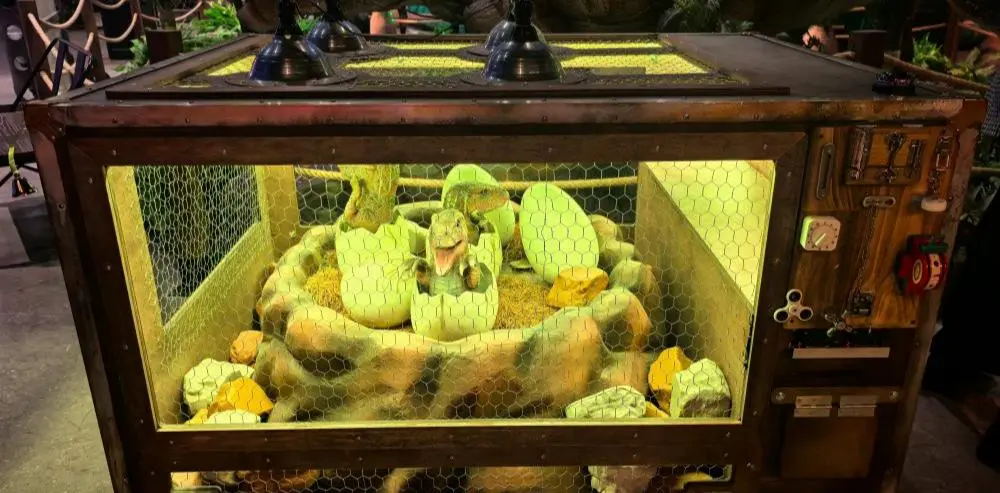
To achieve this, institutions rely on highly accurate, museum-quality replicas. Whether it is a delicate, feathered dinosaur hatchling nestled in a reconstructed nest, or a dynamic scene showing a herd of juveniles, the anatomical accuracy of the models is non-negotiable.

Related Project Experience
Applying scientific storytelling principles in physical spaces requires a deep understanding of both paleontology and structural engineering. Sanhe applies paleontological research, anatomical references, and storytelling principles when developing displays for a dinosaur museum exhibit. By combining juvenile dinosaur models, adult specimens, fossil replicas, and immersive environments, Sanhe Creature helps museums and educational attractions create complete prehistoric life-cycle exhibits with scientific accuracy and long-term operational durability.
Explore our capabilities in creating scientifically accurate displays:
Frequently Asked Questions: What Are Baby Dinosaurs Called
What is the most accurate term for a baby dinosaur?
Scientifically, the universally accepted term is hatchling. As they grow, they are referred to as juveniles.
Are baby dinosaurs called chicks?
Yes, frequently. Because modern birds are the direct descendants of theropod dinosaurs, the word “chick” is often used as an informal comparison when referring to the young of meat-eating dinosaurs.
What is a baby T. rex called?
A baby Tyrannosaurus rex is generally called a hatchling when it first emerges from the egg and a juvenile as it grows. Because no definitive T. rex eggs have been found, scientists rely on bone histology and related species to understand their early life stages.
Did baby dinosaurs look like miniature adults?
Rarely. Fossil evidence shows juveniles often had different body proportions, such as larger eyes, shorter snouts, and different limb ratios. Many also had fluffier feather coverage for insulation.
How fast did baby dinosaurs grow?
It varied by species, but many dinosaurs grew at astonishing rates. Bone studies show large theropods and sauropods experienced massive growth spurts during their juvenile years, gaining hundreds of kilograms annually to reach their massive adult sizes quickly.
Can museums display baby dinosaur replicas?
Yes. Baby dinosaur replicas are commonly used in museum exhibitions, science centers, and educational attractions. They are often displayed alongside adult dinosaurs to explain growth stages, nesting behavior, and prehistoric ecosystems. Professional replicas can be customized in size, pose, feather coverage, and scene design according to exhibition requirements.
Conclusion
So, what are baby dinosaurs called? While “hatchling” is the definitive scientific answer, the reality of their early lives is a complex, fascinating story of rapid growth, adaptation, and in some cases, dedicated parental care.
Understanding these dinosaur growth stages does more than satisfy our curiosity. It provides the foundational science needed to bring the prehistoric world to life. For museums, theme parks, and educational centers, accurately representing these juvenile stages is the key to creating immersive, memorable, and scientifically credible exhibits.
If you are planning an exhibition and need anatomically precise, durable models that tell the complete story of dinosaur life, discuss your project with our engineering team. We specialize in translating complex paleontological data into breathtaking, realistic displays.


