Tell Us About Your Project


Indoor vs Outdoor Animatronics for Theme Parks: What Buyers Should Know
Quick answer: There is no universally better choice between indoor and outdoor animatronics. The right option depends on climate, site conditions, visitor flow, operating hours, and the level of environmental protection your installation can provide. Indoor installations usually offer a controlled environment. Outdoor animatronics require more attention to weather exposure, UV, moisture, corrosion, drainage, and temperature variation.
The mistake we see most often is deciding the environment by default — because there is a spare building, or because there is open land — and letting the specification catch up later. For theme park buyers, the indoor vs outdoor question should be settled at the project design stage, not after the dinosaur has already been manufactured.
One frame makes the whole decision easier: indoor and outdoor animatronics are not two versions of the same product. They are different engineering specifications for different operating environments.
Indoor vs Outdoor Animatronics: What’s Actually Different?
Before choosing, look at what actually changes between the two environments. Not marketing adjectives — engineering variables.
| Factor | Indoor Animatronics | Outdoor Animatronics |
|---|---|---|
| Weather exposure | Limited | Significant |
| UV exposure | Usually limited | Significant |
| Rain / moisture | Generally controlled | Must be addressed |
| Temperature variation | Usually controlled | Can be significant |
| Corrosion risk | Lower | Higher |
| Environmental sealing | Usually simpler | More demanding |
| Site preparation | Usually simpler | Often more demanding |
| Maintenance access | Easier to control | Must account for environment |
| Scenic integration | Interior sets | Landscape and natural terrain |
| Visitor experience | Controlled, immersive | Open-air, large-scale |
Read the table carefully and you’ll notice neither column says “better.” Different operating environments create different engineering requirements. The buyer’s job is to match the specification to the environment — whether the project ends up as indoor animatronics, outdoor animatronic dinosaurs, or a semi-covered mix — and to do it before manufacturing, not after.
Semi-covered installations deserve their own category. A roof can reduce direct rain and sunlight, but it does not necessarily eliminate humidity, wind-driven rain, dust, temperature variation, or corrosion risk.If a creature is exposed to outdoor conditions from one or more sides, specify it the way you would outdoor animatronic dinosaurs — the actual environment decides, not the presence of a roof.
When Are Indoor Animatronics the Better Choice?
Climate-Controlled Environments
Indoor theme parks, museums, science centers, exhibition halls, family entertainment centers. The advantage is not the building itself. It is that fewer environmental variables exist. Every variable you don’t have to engineer for is cost and risk removed from the project.
Projects With Controlled Visitor Experiences
Dark rides, indoor dinosaur exhibitions, immersive walkthroughs, educational exhibits, theatrical environments. Indoors you control lighting, sound, temperature, humidity, and visitor flow. Darkness becomes a design material — encounters can be sequenced the way a director sequences scenes, and sound behaves the way you planned it to.

When Indoor Installation Reduces Engineering Complexity
Let’s be precise about what indoor changes. Outdoor protection does not disappear indoors — dust, heat from lighting, and visitor contact still exist. But the engineering burden is generally lower when the creature is shielded from direct rain, UV exposure, and large temperature swings.
And no, indoor is not maintenance-free. Indoor units carry their own maintenance profile — lighter, usually, but real.
When Do Theme Parks Need Outdoor Animatronics?
An outdoor dinosaur attraction is not the default choice. It is the right choice for specific project types.
Outdoor Dinosaur Trails
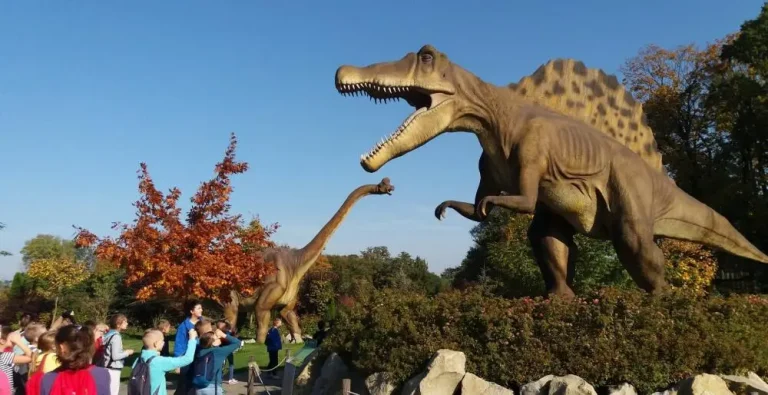
Forest trails, dinosaur parks, outdoor exhibition zones, resort attractions, open-air family attractions. Here the landscape does half the theming work for you. A mature forest can provide a themed environment that would be extremely difficult and expensive to reproduce indoors.

Large-Scale Outdoor Attractions
Five-to-ten-meter dinosaurs, landmark creatures, entrance pieces, central attractions. Scale needs sky. A 12-meter sauropod indoors demands a building most parks do not have. Outdoors, the landmark reads from a distance — from the queue, the parking lot, the road. That visibility is free marketing, and it is something an indoor dinosaur attraction simply cannot offer.
The point to hold onto: an outdoor dinosaur attraction is not an indoor attraction moved outside. It is a different specification from day one.
When the Outdoor Environment Is Part of the Experience
Forest, rockwork, water, natural terrain, open sky. In these projects the environment stops being a backdrop and becomes part of the visitor journey — which is exactly why the experience question has to come before the specification question. The experience question has to come before the specification question. This article covers what the chosen environment demands from the engineering.
What Makes an Animatronic Dinosaur Suitable for Outdoor Use?
This is where buyers should ask for specifics, not adjectives. Four areas decide whether outdoor animatronic dinosaurs survive or struggle.
Weather-Resistant Skin Materials
Silicone and flexible materials face UV exposure and temperature changes outdoors. The hard part is not the flat surfaces — it is the joints. Skin at the neck, jaw, and limbs flexes thousands of times a day while sunlight works on it. That is why the skin on outdoor animatronic dinosaurs cannot be judged by a single adjective — it is a system that must keep flexing while it ages in the open. Ask for the material specification and UV aging behavior, not the word “waterproof.”
Corrosion Protection for the Internal Frame
Steel frame, anti-corrosion treatment, weld areas, fasteners. Moisture finds welds and bolt holes first, long before it bothers the skin. The internal steel frame is where corrosion often starts. for outdoor units, ask specifically what anti-corrosion treatment the frame receives and what happens at the welds.
Waterproofing Electronics and Control Systems
Control box, connectors, cable routing, electrical protection. Water ingress kills the electronics, not the dinosaur. You don’t need an engineering textbook here — you need to know what to ask: where the control box sits, how connectors are sealed, and what [IP rating →] the enclosures carry — the rating tells you what “sealed” actually means. Our [weatherproof guide →] goes deeper into what protected actually means.
Drainage and Site Conditions
Here is the line most buyers miss: even properly specified outdoor animatronic dinosaurs can experience problems if water repeatedly pools around their base or electrical connection points. Site drainage is part of the product conversation, even though it happens on your site, not in the factory.

How Does the Indoor vs Outdoor Choice Change Project Cost?
We’ve written the full budget framework elsewhere — our guide on [what a dinosaur theme park attraction actually costs →]. Here we only look at how the indoor vs outdoor decision shifts the cost structure.
Initial Manufacturing Cost
Outdoor specifications can add cost through weather-resistant materials, protective treatments, sealed electronics, and additional engineering. What surprises budgets is rarely this line — it’s the site work below it.
Site Preparation Cost
Outdoor projects often involve foundations, drainage, electrical infrastructure, cable routing, and crane access. An indoor dinosaur attraction skips much of that — and then spends on the building side instead: HVAC, fire codes, lighting rigs, theatrical systems. The money doesn’t disappear. It moves.
Long-Term Operating Cost
Outdoor installations may require more planned inspection and environmental protection than comparable indoor installations. We won’t expand maintenance cycles here — Outdoor installations may require more planned inspection and environmental protection than comparable indoor installations.
Which Is More Expensive? Not Necessarily.
An indoor project with a giant scenic environment, lighting, HVAC, and theatrical systems can outspend an outdoor trail that runs through an existing forest with simple paths and existing electrical infrastructure. Environment type alone does not determine project cost. What determines it is environment + engineering requirements + site infrastructure + experience design.
How Climate Changes the Outdoor Animatronic Specification
Design for your worst month, not your postcard month. Every climate stresses these units differently, and indoor animatronics are shielded from most of these extremes.
Hot and Sunny Climates
UV, heat, silicone aging, electronics temperature, paint fading. In these climates, shade planning matters as much as material specification — a canopy over a creature can do more for skin life than any coating.
Humid and Rainy Climates
Moisture, corrosion, drainage, electrical protection. Water needs a designed path away from the base and the connection points. Rain itself is only part of the problem; repeated water exposure, wind-driven rain, and standing water can all increase long-term risk.
Cold or Seasonal Climates
Temperature variation, material flexibility, seasonal operation, winterization. Some parks operate six months a year. In those projects the specification and the winterization plan are one conversation, not two.
When discussing climate with a supplier, provide actual site conditions — temperature range, rainfall, humidity, UV exposure, and seasonal operating conditions — rather than relying on a general climate label.
Before Requesting a Quote: Confirm These 8 Items
- Installation environment — indoor, semi-covered, or fully exposed
- Climate and worst seasonal conditions
- Daily operating hours
- Expected movement cycles
- Visitor contact level
- Control-box location
- Foundation and drainage conditions
- Required weather-protection specification
These are your project data. The more complete they are, the more comparable any quotation becomes. Then ask the supplier the four questions that actually protect you:
- What level of weather protection is included in the quotation — in writing?
- What maintenance access does the installation allow?
- Who handles installation and commissioning?
- What happens after the warranty period ends?
A Simple Decision Framework: Indoor, Outdoor, or Hybrid
Choose indoor when: the environment is controlled, the attraction sits inside a building, sound and light control matter, year-round indoor operation is planned, or the site has limited outdoor space.
Choose outdoor when: the natural landscape is part of the experience, large-scale creatures are desired, the visitor trail is open-air, or outdoor scenery is central to the concept.
Consider hybrid when: you want an indoor visitor center plus an outdoor dinosaur trail, an indoor immersive show plus an outdoor scenic zone, or an indoor museum plus an outdoor dinosaur garden. Hybrid is often the smartest answer: one budget, two experiences — and the indoor hall gives the outdoor trail a bad-weather fallback.
| Project Type | Recommended Environment |
|---|---|
| Indoor museum | Indoor |
| Indoor theme park | Indoor |
| Outdoor dinosaur trail | Outdoor |
| Forest dinosaur attraction | Outdoor |
| Large open-air dinosaur park | Outdoor |
| Museum + dinosaur garden | Hybrid |
| Immersive show + outdoor trail | Hybrid |
The best choice is not determined by the dinosaur itself. It is determined by the environment in which the attraction needs to operate.
Final Takeaway
Choosing between indoor and outdoor animatronics is ultimately an engineering and operational decision, not simply a design preference. Define the environment, climate, visitor flow, and operating requirements before selecting the animatronic specification.
Planning a theme park project? [Talk to Sanhe→] about your site conditions and attraction requirements. Or explore our [theme park attraction design & execution →] capabilities first.
Frequently Asked Questions
Is it better to use animatronics indoors or outdoors?
Neither is universally better. Indoor offers control — light, sound, climate. Outdoor offers scale and landscape. The right choice follows the experience you’re building and the climate you’re building in.
Can animatronic dinosaurs be used outdoors?
Yes — with the right specification: weather-resistant skin, sealed electronics, a corrosion-protected frame, and proper foundation and drainage. Outdoor suitability is an engineering decision, not a product category.
Are outdoor animatronic dinosaurs waterproof?
They can be engineered for outdoor weather exposure, but “waterproof” should not be treated as a blanket specification. Protection includes sealed control boxes and connectors, weather-resistant skin, UV resistance, and site drainage. Water pooling at the base can be as damaging as rain on the skin.
Are outdoor animatronics more expensive than indoor ones?
Per unit, outdoor specification adds cost — materials, sealing, protection. At project level, not necessarily. An indoor hall with HVAC, lighting, and theatrical systems can outspend an outdoor trail through an existing landscape.
How does climate affect outdoor animatronic dinosaurs?
UV ages skin and fades color. Moisture drives corrosion. Temperature cycles stress materials and electronics. The specification should be matched to your worst month, not your average weather.
Can an indoor animatronic dinosaur be installed outdoors?
Sometimes, but it depends on the original specification. Retrofitting weather protection after manufacturing can require additional materials, sealing, corrosion protection, electrical changes, and testing — and a harsher-environment specification still has to be checked against the indoor site’s structural, electrical, fire-safety, and operational requirements. For a new project, it is usually more efficient to define the environmental specification before production begins.
What should buyers check before purchasing outdoor animatronics?
Skin material and UV behavior, frame corrosion treatment, electronics sealing and IP ratings, foundation and drainage requirements, warranty scope, spare parts, and maintenance access — confirmed in writing before comparing prices.