Tell Us About Your Project

How Much Does a Dinosaur Theme Park Attraction Cost? A Real-World Budget Guide
Quick answer: There is no universal price for a dinosaur theme park attraction. The total budget depends on the number and type of dinosaurs, site conditions, scenic theming, visitor infrastructure, interactive systems, transportation, installation, and long-term operations.
Anyone who quotes you a single number without seeing your site is guessing. A realistic dinosaur theme park cost plan covers far more than the creatures. It includes scenic theming, visitor infrastructure, electrical and control systems, transportation, installation, site preparation, and the operational provision you’ll need long after opening day.
Part of the confusion comes from mixing up three different numbers:
- The cost of one animatronic dinosaur — a manufacturing question
- The dinosaur attraction cost — the installed, running experience
- The total project cost — the full cost to build a dinosaur attraction, everything required to open the doors
Individual dinosaur manufacturing costs are driven by size, movement count, materials, and engineering requirements; our guide on [how animatronic dinosaurs are made →] covers that side. This article handles the other two numbers — the ones that actually shape your dinosaur attraction budget.
What Is Included in a Dinosaur Theme Park Attraction?
Define scope before money. Most budget surprises come from line items the buyer never considered part of “the attraction.”
Animatronic Dinosaurs
The obvious one. Number of creatures, size range, species mix, movement complexity, customization. A 3-meter raptor with four movements and a 12-meter Brachiosaurus with synchronized neck, head, and vocal effects are different engineering projects, not different sizes of the same product.
Themed Environment and Scenic Elements
Rockwork, artificial vegetation, geological scenery, themed structures, fences, signage. The same dinosaur has very different commercial value depending on the world built around it. A T. rex on bare grass is a statue that moves. A T. rex breaking through a rock face is an attraction.
Visitor Infrastructure
Walking paths, viewing areas, queue zones, barriers, accessibility, lighting, safety signage. These scale with site size, not with dinosaur count — which is why the theme park attraction cost of two projects with identical creature packages can still differ enormously.
Audio, Lighting, and Interactive Systems
Dinosaur sound effects, ambient audio, motion sensors, trigger systems, lighting. Well-designed audio and interaction can significantly increase perceived immersion without requiring another large creature.
Transportation, Installation, and Commissioning
Packing, international freight, unloading, assembly, positioning, electrical connection, motion calibration, testing. The factory quotation and the delivered, running attraction are not the same number.
| Budget Category | What It May Include |
|---|---|
| Animatronic creatures | Fabrication and customization |
| Scenic theming | Rockwork, vegetation, environmental elements |
| Visitor infrastructure | Paths, barriers, viewing areas |
| Audio & lighting | Sound systems, lighting effects |
| Control & interaction | Sensors, triggers, control systems |
| Transportation | Packing and freight |
| Installation | Assembly and commissioning |
| Site preparation | Foundations, drainage, utilities |
| Maintenance provision | Spare parts and planned service |
| Contingency | Project-specific unexpected costs |
That table is a checklist, not a percentage breakdown — every project weights the lines differently. But if a cost line isn’t in your dinosaur attraction budget, it isn’t eliminated. It’s simply postponed.
What Drives the Cost of a Dinosaur Attraction?
Attraction Size
Small trail, medium zone, large immersive attraction, multi-zone park. Each step up adds scenery, infrastructure, lighting, and operational planning — even when the dinosaur count barely moves. One distinction matters here: site size is not dinosaur size. A large share of the dinosaur theme park cost scales with ground — paths, cabling, theming — not with creatures, which is exactly why estimating the cost to build a dinosaur attraction from a creature list alone fails.
Number and Mix of Dinosaurs
Twenty dinosaurs is not automatically half of forty. The mix matters as much as the quantity: large landmark creatures carry the visual weight, medium supporting creatures fill the journey, small creatures and juveniles create the close-up moments. Predators, herbivores, interactive creatures each carry a different engineering profile — and a different price.

Attraction Experience Level
Three broad levels explain more of the dinosaur attraction cost than any other variable:
- Basic Dinosaur Trail — dinosaurs + pathway + limited theming
- Immersive Dinosaur Zone — dinosaurs + scenery + sound + lighting + interaction
- Full Dinosaur-Themed Attraction — multiple zones + storytelling + scenic environment + infrastructure + interactive systems
The cost is set by the experience being built, not by the number of dinosaurs purchased.
Site Conditions
Indoor or outdoor, climate, terrain, existing infrastructure, electrical availability, drainage, foundation requirements, equipment access. An existing park with power and paths at the fence line is a different project from a greenfield site two kilometers from the nearest transformer — the theme park attraction cost difference between those two sites is a civil engineering question before it’s a dinosaur question.
Customization and Storytelling
Custom species, poses, special movement sequences, interactive behaviors, colors, educational or narrative elements. Customization is also where the budget can quietly climb: a custom pose on one dinosaur is a line item; a custom narrative across a whole zone is a design program.
Three Dinosaur Attraction Budget Scenarios
We won’t publish fixed prices here — honest ranges depend on your market and your specification. The scenarios below are illustrative planning examples rather than industry standards; actual scope depends on your site, visitor flow, and the experience you’re building.
Scenario 1 — Small Dinosaur Trail
An existing park or attraction, limited site area, a small-to-medium creature collection, basic scenic integration, existing visitor infrastructure. Budget lines: creature package, basic theming, transportation, installation, electrical connection. For many operators this is the right entry point — a controlled way to learn how a dinosaur attraction budget behaves in real operation.
Scenario 2 — Immersive Dinosaur Zone
A larger visitor area, mixed dinosaur sizes, more extensive scenery, sound and lighting, interactive elements, dedicated visitor circulation. Add scenic construction, interactive systems, electrical infrastructure, and heavier commissioning. This is the level where the total cost starts being driven by infrastructure as much as by creatures.
Scenario 3 — Full Dinosaur-Themed Attraction
Multiple themed zones, large landmark creatures, custom scenic environment, visitor facilities, interactive storytelling, significant site development. At this level you are not buying dinosaurs; you are developing an attraction, and the dinosaur attraction budget should be structured like one.
How many creatures each scenario needs is a separate planning question — site area, visitor flow, and scene design set that number before budget does. Our guide on [how many animatronic dinosaurs a 1,000–3,000 sqm site actually needs →] covers that side in detail.
Why Two Dinosaur Attraction Projects Can Have Completely Different Budgets
Project A: existing theme park, outdoor trail, 15 dinosaurs, basic theming, existing power and paths, limited installation work.
Project B: new attraction zone, 30+ dinosaurs, multiple large landmark creatures, custom scenery, interactive systems, new visitor infrastructure, international installation crew.
Both owners will say “we bought dinosaurs.” Comparing them by number of dinosaurs × unit price produces a meaningless number. The total project cost can differ substantially even when the creature packages look similar on paper. The gap in total theme park attraction cost often has as much to do with site development, infrastructure, theming, and installation as it does with the dinosaurs themselves.
What Costs Are Often Overlooked?
This is the section that saves budgets — the project cost lines that get forgotten until invoice time.
Site Preparation
Large creatures may require engineered foundations, while visitor traffic can also create drainage and ground-preparation requirements that are easy to overlook.
Electrical Infrastructure
Power capacity, distribution, outdoor protection, control locations, cabling. Animatronics are modest power consumers compared to rides, but cable runs across a large site are a real civil cost.
Transportation and Customs
Sticker prices mislead here. The cost to build a dinosaur attraction never equals the factory quotation once freight, duties, and site delivery enter the picture. Freight terms decide who carries the risk — understand what [international trade terms like FOB, CIF, or DDP →] actually shift onto your side. Customs duties vary by market and by how the creatures are classified.
Installation Equipment
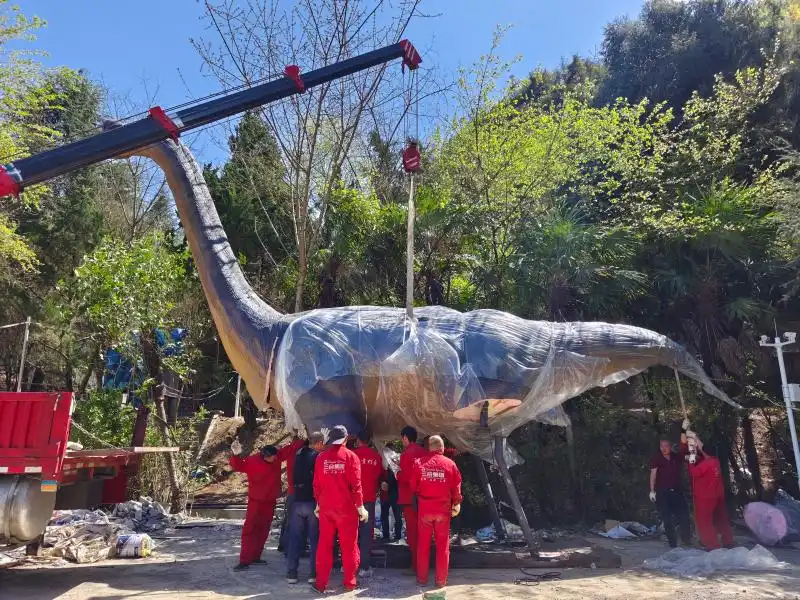
Cranes, lifting equipment, access equipment, local labor. The line item nobody pictures: a crane day-rate on a site with no road access for the crane. That single oversight can move the installed cost more than a creature upgrade.
Spare Parts and Maintenance
Critical spare parts, routine maintenance, replacement components, technical support. Budget these before opening, not after the first failure. Including a first-year maintenance provision in your initial dinosaur attraction budget prevents operational surprises down the line.
How to Build a Project Brief Before Requesting Quotes
The more complete the brief, the more comparable the quotations.
Step 1 — Define the site. Location, area, indoor/outdoor, climate, existing infrastructure.
Step 2 — Define the visitor experience. Walk-through trail, interactive zone, educational attraction, immersive themed environment. If you haven’t done this work yet, start with our guide on [how animatronic dinosaurs transform theme park visitor experiences →] — the experience defines everything downstream.
Step 3 — Create the dinosaur mix. Species, quantity, sizes, landmark creatures, supporting creatures.
Step 4 — Define movement and interaction. Basic movement, advanced movement, visitor-triggered interaction, audio synchronization.
Step 5 — Define theming and installation. Natural environment, rockwork, vegetation, signage; then shipping, site access, assembly, electrical connection, commissioning.
Then build the total: creatures + theming + infrastructure + logistics + installation + maintenance provision + contingency. That sum — not any single quote — is your working dinosaur attraction cost. Send the same brief to two or three suppliers so your dinosaur attraction budget comparisons are honest. Different briefs produce different quotes, and different quotes produce bad decisions.
How to Compare Dinosaur Attraction Quotes
The lowest quotation is not necessarily the lowest total project cost. Compare scope of supply, not headline price. And remember what you’re actually comparing: slices of the total cost to build a dinosaur attraction, not the whole thing.
Dinosaur specifications, quantity, movement functions, materials, weather protection, control systems, theming scope, shipping responsibility, installation scope, commissioning, warranty, spare parts, technical documentation, after-sales support.
If two quotations differ significantly, do not assume you are looking at the same scope at different prices. Check which line items, specifications, responsibilities, or services differ between them.
Is a Dinosaur Attraction Worth the Investment?
A dinosaur attraction can drive visitor numbers, dwell time, photo sharing, repeat visitation, seasonal programming, and merchandise. Whether it’s “worth it” depends on visitor volume, ticket pricing, operating costs, capacity, seasonality, and your park’s overall business model. Evaluate the total project cost as part of the park’s visitor and revenue strategy — not by the price tag on the dinosaurs, and not by anyone’s promised ROI, including ours.
Final Takeaway
The dinosaur theme park cost question has an honest answer: it is not set by the price of a single dinosaur. It is set by the scale, the experience, the site, the infrastructure, and the operational requirements of the whole project.
Think in total project cost, not dinosaur unit price.
If you want to talk through your concept, site conditions, creature mix, and project requirements, [talk to Sanhe Creature →]. Or explore our [theme park attraction design & execution →] capabilities first.
Frequently Asked Questions
How much does a dinosaur theme park attraction cost?
There is no universal number. A small trail, an immersive zone, and a full themed attraction are different project classes, and the dinosaur theme park cost spans creatures, theming, infrastructure, logistics, installation, and maintenance — not just the creature package. Plan the dinosaur attraction budget across all those lines, and the question stops being scary. The correct starting point is to define the attraction scope before asking for a price.
Besides the dinosaurs, what adds to the cost to build a dinosaur attraction?
Five lines buyers often forget: site preparation and foundations, electrical infrastructure, transportation and customs, installation equipment and labor, and spare parts. The creature package is usually only part of the total project budget — the lines underneath it are where budgets go over.
How much does an animatronic dinosaur cost?
Individual animatronic dinosaur prices vary substantially depending on size, movement systems, materials, customization, weather requirements, and engineering complexity.
Are installation and shipping included in the dinosaur price?
Scope varies by supplier and project. Some quotations stop at FOB; others include delivery, installation, and commissioning. Confirm freight terms and installation responsibility in writing before comparing prices.
How many dinosaurs are needed for a dinosaur attraction?
Quantity follows site size, visitor flow, scene design, and the experience you’re building — it’s a planning question, not a purchasing question. We cover it in a dedicated guide on matching creature count to site area, including the 1,000–3,000 sqm range most operators start with.
Is a dinosaur attraction profitable?
It can be — but profitability depends on visitor volume, ticket strategy, operating costs, and seasonality, not on the attraction alone. Treat the attraction’s total cost as one input into your park’s overall business model, and plan the revenue side with the same rigor as the budget side.