Tell Us About Your Project

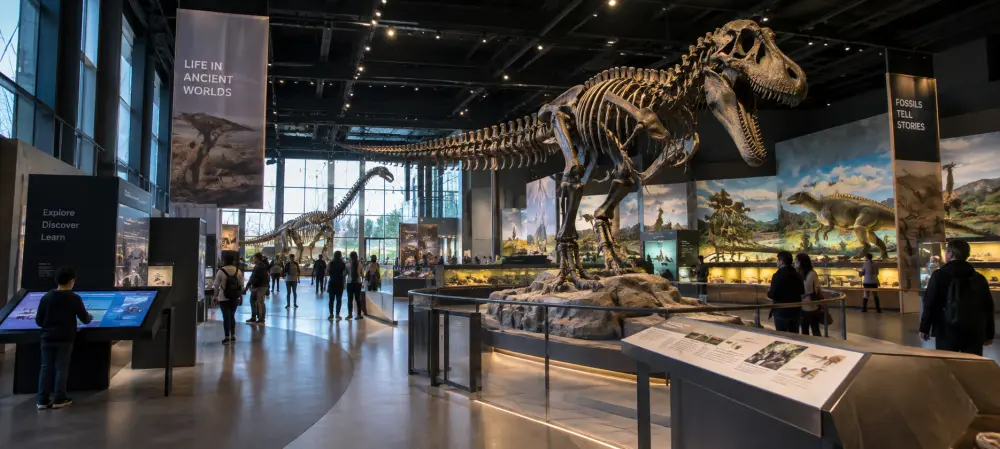
How to Design a Museum Dinosaur Exhibition for Learning and Visitor Engagement
A museum dinosaur exhibition can contain scientifically accurate fossils, life-size reconstructions, interactive displays, and rich educational content—and still fail to create a meaningful visitor experience.
The problem is often not the quality of the individual exhibits, but how they work together. A museum can have excellent fossils, reconstructions, and interactive displays, yet visitors may still leave without understanding the central ideas the exhibition was designed to communicate.
Designing a museum exhibit—especially one focused on dinosaurs—isn’t about deciding what cool stuff to display. It’s about designing how people move through the space, what they notice, what they understand, and what they actually remember when they get home.
A practical museum exhibit design process typically follows this flow:
Learning Goals → Exhibition Narrative → Visitor Journey → Spatial Planning → Interactive Elements → Interpretation → Engineering & Operations → Budget → Evaluation
This guide walks through each stage, explaining how to approach museum exhibit design for a dinosaur exhibition, from the initial learning objectives all the way through to long-term operation.
Start With Learning Goals Before Designing the Exhibit
Here’s where many projects go wrong: they start with the exhibits.
“We need a T-Rex.” “Let’s get a Brachiosaurus.” “Can you make it breathe fire?”
But effective museum exhibit design works the other way around. You start with what you want visitors to learn, then figure out what exhibits will actually help them learn it.
Define What Visitors Should Learn
Before you even look at a catalog, sit down with your team and answer some basic questions:
- What should visitors actually understand when they leave? Not just “dinosaurs are cool”—but what specific concepts? Are you trying to teach them about evolution, extinction, or how paleontologists reconstruct prehistoric life?
- What misconceptions do you need to address? A lot of people still think all dinosaurs lived at the same time, or that they were all giant monsters. Your exhibition needs to tackle that head-on.
- Who are you serving? A university research museum has different priorities than a children’s discovery center. The age groups you’re targeting will dictate everything from text panel reading levels to exhibit heights.
- What’s the single most important thing visitors should remember? Answering these foundational questions is the first step in building a focused and effective exhibition.
Match Content to the Museum’s Educational Mission
This seems obvious, but it’s worth stating: your dinosaur exhibition needs to fit your institution’s broader mission.
If you’re a research-focused natural history museum, your design priorities will lean heavily toward scientific accuracy and detailed interpretation. If you’re a hands-on science center, you’ll prioritize interactive elements and experiential learning.
When designing a museum exhibit, aligning the content with your institution’s mission ensures long-term relevance and institutional support.
Turn Learning Objectives Into Interpretive Goals
Once you’ve got your goals clear, translate them into interpretive goals: what visitors should see, question, compare, or understand at each stage of the exhibition.
Let’s say your objective is to demonstrate predator-prey dynamics in a Cretaceous ecosystem. Your interpretive goal might be: visitors should understand how fossil evidence reveals feeding behavior. Your design solution could then be: a fossil display showing actual predator and prey specimens, paired with a reconstructed behavioral scene, supported by concise graphic interpretation explaining the evidence.
The exhibit is just the vehicle. The learning objective is the destination. Don’t confuse the two.
Build a Clear Narrative for the Dinosaur Exhibition
Visitors are more likely to understand and connect individual facts when those facts are organized around a coherent narrative.
If your museum dinosaur exhibit feels like a random collection of cool stuff, visitors may leave with an impression of the objects without understanding the larger story behind them. But if you weave those exhibits into a coherent narrative, they’ll leave with actual understanding.
Choose One Central Narrative
Here’s the temptation: to cover everything. Evolution, geology, extinction events, the history of paleontology, Jurassic Park references, climate change parallels…
Don’t do it.
Pick one central narrative and stick to it. For example:
- How dinosaurs adapted to diverse environments over millions of years
- How paleontologists reconstruct prehistoric life from fragmentary evidence
- The ecological relationships within a specific prehistoric ecosystem
- What the fossil record actually tells us about extinction
You can touch on other topics, sure. But one narrative should be the through-line that ties everything together.
Organize the Exhibition Into Logical Chapters
Once you’ve got your narrative, break it into chapters. Organizing the exhibition into logical chapters gives visitors a sense of journey.
A progression like Origins → Environment → Behavior → Evidence → Extinction helps them feel like they’re moving through a story, not just wandering past unrelated displays. There should be a logical flow where each section builds on the previous one.
Balance Visual Impact With Deeper Information
Good exhibition design uses what we call “layered storytelling.”
From across the gallery, a massive skeletal mount or life-size reconstruction grabs attention. That’s your hook. As visitors approach, short, accessible text panels provide context—just enough to satisfy casual browsers.
But for visitors who want to dive deeper, you need interactive elements or detailed graphics that offer specialized information. This layered approach accommodates different levels of visitor interest. Some people will scan the highlights, while others may spend much longer with detailed interpretation. Good exhibition design gives both groups a clear way to engage. Interpretation should connect the visual experience with the evidence behind it, helping visitors understand not only what they are seeing, but why it matters.
Design the Visitor Journey, Not Just the Exhibition Space
Museum exhibit design is fundamentally about choreographing human behavior. The physical space has to guide the visitor experience intuitively, without them even realizing it’s happening.
Plan How Visitors Enter, Move, Pause, and Exit
Think about the entire circulation path from start to finish.
Where’s the natural entrance? Is it obvious, or will visitors wander around confused? Are there clear pathways that prevent bottlenecks when school groups arrive?
More importantly: where are the “pause” zones? Places where visitors can sit, reflect, or interact without blocking the main flow? You need those. Otherwise, you get congestion around popular exhibits and frustrated visitors.
And the exit should feel like a natural conclusion to the journey, ideally leading toward the next gallery or a concluding space. Don’t just dump people into a hallway.
Create Focal Points Along the Route
You can’t make everything equally exciting. If you try, nothing stands out.
Instead, strategically place high-impact elements to draw visitors through the space. A life-size reconstruction, a rare fossil, a dynamic interactive installation—these serve as visual anchors.
The key question: What deserves the visitor’s primary attention at each stage of their journey?
Not everything does. And that’s okay.
Avoid Overloading the Gallery
This is one of the most common mistakes we see: trying to fit too much into a limited footprint.
Too many large exhibits, excessive text, narrow circulation paths, or competing focal points will overwhelm visitors. Negative space is a powerful tool in museum exhibit design. It lets the exhibits breathe and gives visitors’ brains time to process what they’ve just seen.
Let the Space Do Part of the Teaching
The physical dimensions and layout of your gallery are critical components of museum exhibit design. They directly dictate how exhibits are perceived and experienced.
Consider Scale and Viewing Distance
A 15-meter sauropod and a small, detailed fossil specimen require completely different spatial strategies.
Large exhibits demand high ceilings, wide viewing distances, and clear sightlines. If you cram a massive animatronic into a low-ceilinged space, visitors won’t appreciate its scale—they’ll just feel cramped.
Smaller, detailed exhibits need the opposite: controlled lighting, lower display cases, closer viewing distances. You want visitors to lean in and examine the details.
Think about this upfront, not after you’ve already ordered the exhibits.
Plan Sightlines Carefully
Sightlines should be planned at both adult and child viewing heights, especially when large reconstructions dominate the gallery.
Consider what visitors see when they first enter. What do they see as they move through? Does a large dinosaur block the view of other important exhibits? Can children see over barriers, or do they just see legs? Careful sightline planning is often what separates a thoughtful exhibition layout from a frustrating one.
Create Different Levels of Engagement
Visitors engage at different levels: some primarily look and observe, while others want to explore, interact, and go deeper into the subject.
The spatial layout should naturally separate high-energy interactive zones from quieter, observation-focused areas. Otherwise, competing sounds, movement, and visual stimuli can make the space harder to navigate and the content harder to process. Creating these distinct zones can make the exhibition easier to navigate and the content easier to process.
Design for Different Visitor Ages and Needs
A well-designed exhibition is inclusive. This isn’t just about compliance—it’s about good design.
Can children in wheelchairs see the exhibits? Are there seats for elderly visitors or parents with strollers? Are interactive elements accessible to users with varying physical abilities?
Designing primarily for able-bodied adults can make an exhibition less accessible to a significant part of its audience.
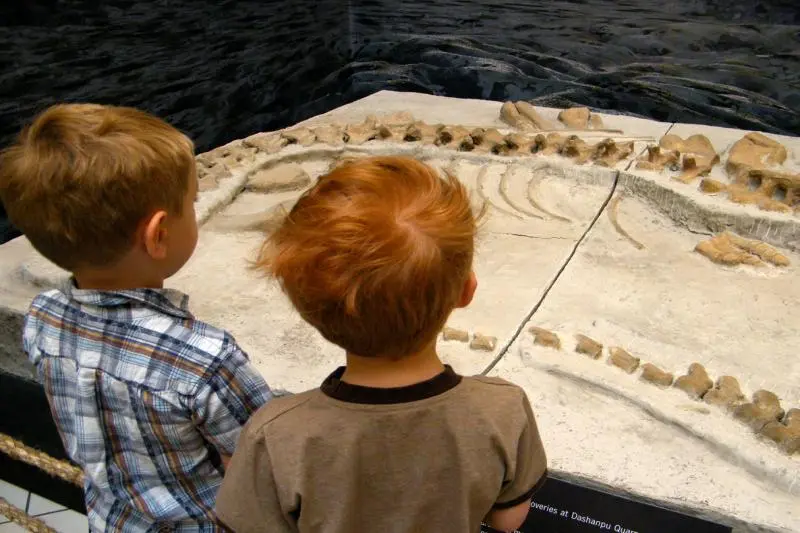
Choose Interactive Elements That Support the Story
Here’s something we see way too often: interactive elements added just because “museums need interactives now.”
Don’t do that. In modern museum exhibit design, every interactive element must serve the central narrative.
Use Interaction to Answer a Question
Effective interactives usually have a clear purpose: helping visitors explore a specific question or concept.
How fast could this dinosaur move? Maybe a kinetic display comparing stride lengths.
What did its environment look like? A projection mapping system showing the prehistoric landscape.
How did scientists know what it ate? A hands-on fossil comparison station.
See the difference? The interaction has a purpose. It’s not just a screen for screen’s sake.
Combine Physical and Digital Interaction
Digital screens have their place. But physical interaction can provide another way for visitors to explore a concept without relying entirely on screens or text.
Consider combining mechanical movement, soundscapes, tactile models, or projection mapping with traditional displays. The goal is multi-sensory engagement that reinforces the educational message, not distracts from it.
If an interactive experience requires visitors to download an app before they can use it, consider whether the added friction is justified by the educational value.
Use Animatronic Dinosaurs Where Movement Adds Educational Value
When integrating dynamic elements into a museum dinosaur exhibit, the focus has to remain on educational utility, not just spectacle value.
Use Movement to Demonstrate Behavior
Movement is powerful. But it has to mean something.
Head turns, neck extensions, breathing motions, jaw movements—these aren’t just cool effects. They can demonstrate behaviors like feeding, territorial displays, or parental care that static objects simply cannot communicate as clearly.
If the movement doesn’t have a clear interpretive purpose, don’t include it.
Combine Animatronics With Fossils and Interpretation
Animatronics shouldn’t exist in a vacuum. Their impact is magnified when placed in direct dialogue with scientific evidence.
Positioning a life-size, breathing reconstruction next to the fossil evidence it is based on can help visitors connect the physical evidence with the reconstructed animal. This integration of evidence and reconstruction is a best practice in museum exhibit design.
The movement, posture, scale, and behavior represented by an animatronic should be consistent with the scientific interpretation presented in the exhibition. The goal is not to make the dinosaur move as much as possible. The goal is to make the reconstruction communicate something that visitors can understand.
Plan Large-Scale Exhibits Around the Space
Introducing a massive animatronic figure requires rigorous spatial planning.
You need to account for ceiling height. Structural load-bearing capacity. Maintenance access panels. The viewing distance required for visitors to safely appreciate the scale without feeling intimidated or cramped.
For large or mechanically complex exhibits, exhibition planning and engineering should develop together rather than treating engineering as a fabrication-stage problem.
These aren’t afterthoughts. They’re fundamental design decisions that need to happen upfront.
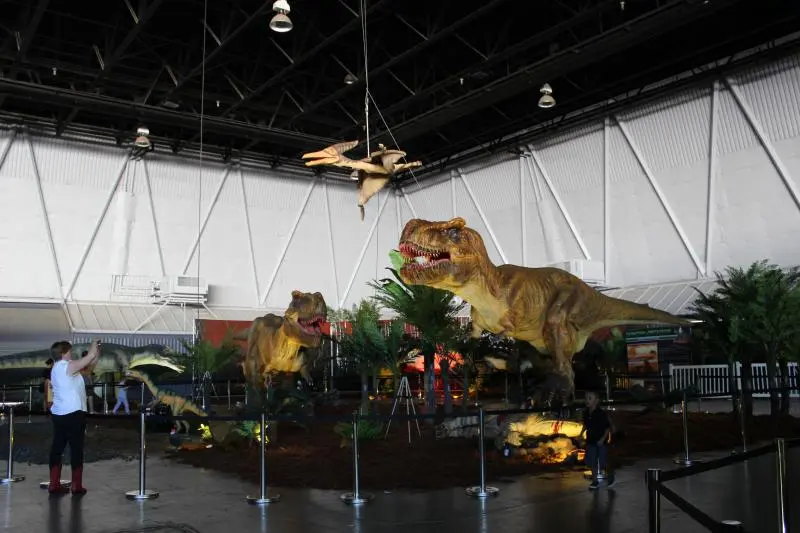
For museums considering life-size dinosaur reconstructions, movement, scale, materials, and control systems should be considered alongside the exhibition concept. Animatronic dinosaurs can be developed around specific educational themes, visitor flow, and installation requirements rather than treated as standalone display pieces.
Design for Durability and Long-Term Museum Operation
Long-term durability is a non-negotiable aspect of professional museum exhibit design. An exhibit that looks impressive on opening day but is difficult to maintain will quickly become an operational liability.
Plan Maintenance Access From the Beginning
Can technicians easily access the internal mechanisms of an animatronic figure? Can a broken screen or worn-out interactive component be replaced without dismantling the entire scenic structure?
Maintenance access should be considered during the design stage, because inaccessible components can increase downtime, complicate routine servicing, and make repairs more disruptive to normal museum operations.
Designing for serviceability saves significant time and money over the exhibit’s lifespan. It’s not glamorous, but it’s essential.
Consider Materials and Environmental Conditions
The operating environment dictates material choices.
Materials selected for indoor galleries may not withstand prolonged UV exposure, moisture, or temperature fluctuations outdoors. Material selection should therefore reflect the actual operating environment.
Exhibits in high-humidity environments need different materials than those in climate-controlled galleries. Outdoor installations require specialized, durable materials and protective coatings.
Design for Daily Operation
Daily operation considerations are often overlooked in museum exhibit design, but they are critical.
Are the exhibits easy to clean? Are interactive controls intuitive for visitors to use without constant staff intervention? An exhibit must be robust enough for real-world use. Beautiful but fragile exhibits create ongoing operational challenges.
Plan the Exhibition Around Budget and Project Constraints
Design doesn’t happen in a financial vacuum. Practical constraints must shape creative decisions from the outset of any museum exhibit design project.
Separate Must-Have and Nice-to-Have Elements
When resources are limited, you need to prioritize the core narrative and protect the elements that carry the most educational value.
Must-have: Core fossil interpretation, the main narrative flow, one or two key focal exhibits.
Nice-to-have: Additional secondary interactive systems, advanced digital media, extra animatronic figures.
Protect the must-haves first. Treat the nice-to-haves as flexible elements that can be scaled based on the final budget.
Consider Total Cost Beyond Initial Fabrication
The initial fabrication cost is only one part of the equation. A realistic museum exhibition budget also needs to account for installation, routine maintenance, component replacement, and ongoing energy consumption.
A lower initial cost does not necessarily mean a lower total cost over the life of the exhibition. Think long-term.
Evaluate Whether the Exhibition Is Working
Continuous evaluation is essential to ensure your museum exhibit design is actually meeting its goals. When designing a museum exhibit, the process doesn’t end when the exhibition opens. Visitor research and evaluation can help museums understand how people experience an exhibition and identify opportunities for improvement over time.
Measure Visitor Behavior
Observe how people actually use the space. Not how you think they’ll use it—how they actually use it.
Track metrics like dwell time at specific exhibits, natural stopping points, interaction rates with hands-on elements. Are visitors following the intended path, or are they bypassing certain sections entirely?
The data will tell you things you can’t see just by watching.
Evaluate Learning Outcomes
Conduct informal interviews or surveys with visitors, particularly school groups.
Did they understand the intended concept? Did the exhibit successfully address the initial learning objectives you defined at the start of the project?
If the answer is no, you need to know that.
Use Feedback to Improve the Exhibition
Evaluation data should inform future iterations.
If an interactive element is constantly breaking, it needs redesigning. If a particular graphic panel is being ignored, the text needs to be simplified or repositioned.
Design is an iterative process: Design → Observe → Evaluate → Improve.
The exhibition you open with won’t be the exhibition you have five years later. And that’s okay. It’s actually how it should be.
Final Takeaway
Effective museum exhibit design starts with the visitor and the learning goal—not the exhibit itself.
For a museum dinosaur exhibit, fossils, replicas, animatronics, graphics, and interactive elements shouldn’t be viewed as isolated products. They’re tools that have to work together as integrated parts of one coherent visitor journey.
For projects involving large-scale animatronic dinosaurs or complex interactive physical exhibits, early coordination between exhibition planning, engineering, fabrication, and installation is critical.
The result is an exhibition that can support its educational goals while remaining practical to operate, maintain, and update throughout its planned lifespan. That is the true measure of successful museum exhibit design.
Planning a Museum Dinosaur Exhibition?
If you’re developing a museum dinosaur exhibition and already have a project area, concept, or initial scope in mind, our engineering team can help assess the requirements from the early planning stage.
Share your project area, exhibition concept, and initial requirements with us, and we can discuss suitable animatronic solutions, spatial considerations, and project requirements.


