Tell Us About Your Project


Animatronics vs Puppetry vs Projection: Choosing the Right Tech for Your Show
A director is planning a character-driven production. The creative team has a clear vision for how this character should appear, move, and interact with performers. But when it comes to actually bringing that vision to life, there are multiple paths forward.
The team could build an animatronic character with programmed movements, develop a puppetry system driven by live performers, or use projection to create a digital presence. Or they might combine several of these approaches.
The question isn’t which technology is the most advanced. The real question is: which approach—or combination of approaches—can deliver the intended performance within the actual constraints of the production?
This is where understanding different stage technologies becomes essential. Stage technology is not a single system. It encompasses mechanical systems, automation, lighting, projection, sound, control systems, and various physical performance technologies. Each serves different purposes and comes with its own set of requirements.
This article focuses on three distinct approaches to live entertainment technology that can create a strong character or visual presence on stage: animatronics, puppetry, and projection. We’ll examine them not from a “which is better” perspective, but through the lens of actual production requirements: physical presence, performer involvement, repeatability, stage footprint, interaction capabilities, scene changes, touring logistics, and maintenance demands.
The right choice starts with the production requirements, not the technology itself.
The Technology Choice Behind a Successful Show
When a production team selects between animatronics, puppetry, or projection, they are making a decision that reaches far beyond visual appearance. Selecting the right stage technology is a choice that shapes the entire production architecture.
Technology selection influences character design, stage layout, performer movement patterns, rigging requirements, backstage access needs, power distribution, control systems, rehearsal schedules, transportation logistics, and ongoing maintenance protocols. A decision regarding these stage technologies made in the creative development phase ripples through every aspect of planning.
There is no universal solution that works for every show. A production centered on an actor’s physical interpretation of a character may find that puppetry aligns more naturally with its artistic goals. A show requiring a physical character to perform the same programmed movements night after night may be well suited to an animatronic system. A production that needs to shift between multiple worlds and environments rapidly could find projection more suitable.
The decision should start with the show itself. Instead of asking “which technology should we buy?”, the more productive question is: “what does this production actually require?”
Three Ways to Create Presence on Stage
Each of these three approaches creates stage presence in fundamentally different ways. These approaches sit within the broader field of theatre technology, which brings together creative design, technical production, automation, projection, and other systems used in live performance. The United States Institute for Theatre Technology (USITT) provides professional education and resources across these areas.
Animatronics: Engineered Physical Presence
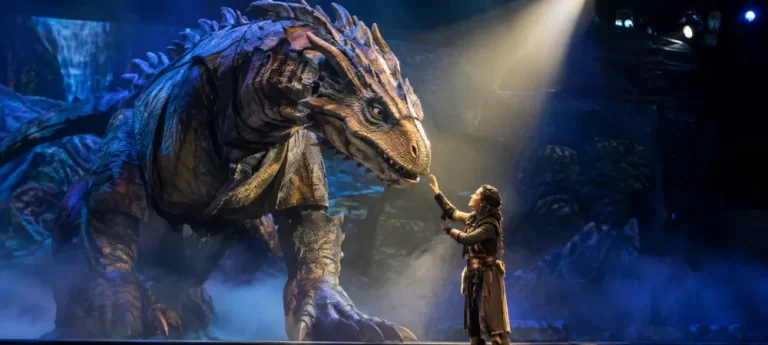
Animatronics creates a physical character or object that exists within the stage environment and uses engineered movement to deliver performance. It relies on a physical body, mechanical systems, and programmed sequences to achieve repeatability and scale.
Puppetry: Human Performance Made Physical
Puppetry keeps the performer at the center of the character. Whether the performer is visible or concealed, their real-time decisions drive the character’s movement, timing, expression, and interaction, relying heavily on human timing and physical execution.
Projection: Digital Presence and Visual Transformation
Projection creates presence through light and digital imagery rather than physical form. It excels at environmental transformation, rapid scene changes, and producing visual storytelling that would be impractical with physical elements alone.

Animatronics, Puppetry and Projection: What Each Does Best
Animatronics: Physical Presence and Repeatable Movement
Animatronics makes production sense when physical presence itself is part of the performance. If the character needs to occupy real space, cast actual shadows, and exist as a three-dimensional form that performers can physically engage with, an animatronic system provides that tangible reality. This applies not only to large characters, but to any stage element requiring dimensional form and a strong physical presence.
When certain movements must happen at precisely the same point in every performance, the repeatability of programmed mechanical movement becomes valuable. Head turns, body movements, breathing motions, tail sweeps, mouth articulation, and timed gestures can all be engineered to occur consistently across hundreds or thousands of performances.
Physical interaction represents another strength. When a character needs to engage directly with performers, move around physical set pieces, or interact with props in real space, a physical character system has natural advantages. The actor can touch the character, stand beside it, move around it, and create genuine spatial relationships.
For long-running productions with daily performances, the combination of repeatability and maintainability becomes increasingly important. An engineered system designed for high-frequency operation can deliver consistent performance while allowing for scheduled maintenance and component replacement.
The engineering burden is part of the advantage. Structural load calculations, stage access planning, transportation logistics, installation complexity, maintenance protocols, power and control integration, and failure tolerance planning all become part of the production equation.
If your production requires a physical character system, our theatrical performance systems are designed around stage integration, performer interaction, movement requirements, and repeated show operation.
Puppetry: Human Performance and Expression
Puppetry excels when a production benefits from human interpretation and real-time performance decisions. A skilled puppeteer can adjust timing, modify gestures, respond to fellow performers, and bring spontaneous creativity to each show. Because timing, gesture, and interaction remain closely tied to the performer, the character can react differently to different performances, adapting to the energy of the room.
When a production depends heavily on live interaction, changing performance rhythms, or direct audience engagement, the performer-driven flexibility of puppetry offers significant advantages. The character can react in the moment, and the performance retains the organic unpredictability of live theatre.
The trade-off appears elsewhere: the performer carries more of the system. Training puppeteers, developing choreography, managing physical demands across repeated performances, and ensuring consistency all demand significant investment. Large puppets can be physically demanding to operate, and the number of available trained performers may limit production scalability.
Projection: Visual Transformation and Scale
Projection’s greatest strength lies in rapid scene transformation. A production can shift locations, change environments, alter atmosphere, move through time, or transform visual context almost instantly. This makes projection particularly valuable for shows with multiple settings, abstract storytelling, or conceptual environments.
Large visual environments become achievable without constructing massive physical sets. A projection system can represent environments that would be difficult, expensive, or impractical to construct as physical scenery.
Like any complex theatrical technology, projection has specific trade-offs involving surface requirements, sensitivity to ambient light conditions, projector positioning, calibration needs, and content production demands. Perhaps most significantly, projection transforms the visual environment but does not physically occupy the stage in the same way a character system does.
Comparing the Three Technologies for Your Production
When evaluating different stage technologies, the comparison below focuses on practical production requirements rather than just features.
This comparison shows that each technology brings different strengths and constraints. The table is not intended to produce a single winner. It is a way to identify which production requirements should carry the most weight in the decision.
| Production Consideration | Animatronics | Puppetry | Projection |
|---|---|---|---|
| Physical presence | Strong dimensional presence | Strong dimensional presence | Digital presence |
| Human performer involvement | Low to medium, depending on control approach | High performer involvement | Low to medium |
| Repeatable movement | Strong mechanical consistency | Performer-dependent consistency | Highly repeatable during programmed playback |
| Character expression | Programmed and engineered | Performer-driven and responsive | Digitally created and content-driven |
| Physical interaction | Strong real-space interaction | Strong real-space interaction | Limited by setup requirements |
| Stage footprint | Higher spatial requirements | Medium to high spatial needs | Lower physical footprint, but requires projection infrastructure |
| Scene changes | Physical change or reset | Physical change or reset | Very fast digital transitions |
| Touring logistics | Transport plus installation complexity | Performer plus equipment logistics | Equipment plus calibration needs |
| Performer workload | Lower when mechanically controlled | Higher physical and creative demands | Generally low |
| Large visual environments | Limited by physical construction | Limited by physical construction | Strong capability |
Five Questions That Should Drive the Technology Decision
Rather than starting with technology preferences, production teams can make clearer decisions by answering five fundamental questions about their specific show. These questions move the decision from creative preference to production feasibility.
What Must Physically Exist on Stage?
Consider what absolutely needs to occupy real physical space. Does the character need to cast actual shadows? Must performers be able to touch and physically interact with it? Does it need to move around other physical elements on stage? Does it need dimensional presence that audiences can perceive from multiple angles?
If the answer to these questions is yes, physical systems like animatronics or puppetry warrant serious consideration. Projection can create powerful visual presence, but it cannot provide the same physical reality as a three-dimensional character system.
How Much Human Performance Is Required?
Ask whether the character itself is performing, or whether a performer is performing through the character. Does the show benefit from improvisation, emotional reaction in real-time, live timing adjustments, or direct audience interaction that responds to the energy of the moment?
If the production depends heavily on these elements, performer-driven systems should become a more important part of the evaluation. Puppetry offers direct performer control. Animatronics can incorporate performer operation or run via programmed sequences. Projection typically offers the least live performance flexibility.
How Often Will the Visual World Change?
Consider whether the show needs one consistent physical environment or many rapidly changing worlds. Does the location shift frequently between scenes? Does the visual environment need to transform quickly? Is the storytelling abstract or conceptual in ways that would benefit from visual flexibility?
If rapid transformation is essential, projection’s value increases significantly. Physical systems excel at creating consistent, tangible presence but require more time and effort to change.
What Are the Stage, Access and Touring Constraints?
This question often determines which theatrical technology is actually feasible. It breaks down into several practical layers:
- Stage load: What is the capacity—not just static weight, but dynamic loads created during movement?
- Access: Can the system fit through loading doors, access backstage routes, use available elevators, and fit in storage?
- Installation: What are the requirements for assembly, floor fixing, rigging, or specific operator positions?
- Touring: How will transport volume, venue compatibility, setup time, changeover requirements, and reset time affect the choice?
These practical constraints sometimes eliminate options before creative considerations even enter the discussion. A technology that works beautifully in theory may prove impossible given specific venue limitations.

How Often Will the Show Run?
The same system designed for ten performances has fundamentally different requirements than one designed for two thousand. The number of performances matters, but so does the number and frequency of movement cycles within each performance. Cycle frequency, reset time between shows, maintenance access during the run, spare component availability, operator workflow efficiency, failure tolerance, and serviceability all become critical factors.
A technology that works well for a short-run production may require completely different engineering approaches for a long-running show. This question often separates conceptual viability from operational reality.
Quick Decision Reference
| If your production needs… | Technology to consider |
|---|---|
| A physical character on stage | Animatronics or puppetry |
| Strong performer-driven expression | Puppetry |
| Repeatable programmed movement | Animatronics |
| Rapidly changing environments | Projection |
| Direct physical interaction | Animatronics or puppetry |
| Minimal physical scenery | Projection |
| Physical and digital storytelling together | Hybrid approach |
Why Some Productions Combine Multiple Technologies
The choice does not always require selecting just one theatrical technology. Many successful productions combine multiple approaches to leverage the strengths of each.
Animatronics Plus Projection
A physical character can exist on stage while projection creates changing environments around it. The character maintains its tangible presence and ability to interact with performers, while the world around it transforms through digital imagery. This combination delivers both physical reality and visual flexibility.
Puppetry Plus Projection
Puppetry provides human performance and expressive character work while projection creates the environment. This works particularly well for performer-driven characters moving through rapidly changing worlds. The performer maintains creative control while the visual setting shifts instantly.
Physical Character Plus Lighting Plus Sound
A stage character truly comes alive through integration. Movement works with lighting cues, sound design, timing, and overall production orchestration. A character system should be treated as part of an integrated stage environment rather than as an isolated element.
Modern theatrical technology increasingly works as an integrated production environment rather than a collection of isolated tools. In live entertainment technology, solutions can combine physical, mechanical, and digital elements around a unified production objective.

From Creative Concept to Stage-Ready System
Once the creative concept and stage technology direction have been established, the next challenge is translating that decision into a stage-ready system.
Character and System Design
If the choice involves a physical system, considerations expand to include scale, movement requirements, structural design, performer interaction points, control systems, and access requirements. For productions that require a purpose-built physical character, custom animatronic systems can be developed around these specific performance and venue requirements. This is where creative vision meets engineering reality, and where the physical constraints of the venue begin to shape the theatrical technology.
Stage Integration
Integrating any system into an actual venue requires strict adherence to constraints. Stage dimensions, access points, static and dynamic load requirements, power availability, control infrastructure, sightlines, backstage space, and installation requirements all shape the final design. A brilliant concept that cannot fit the stage serves no one.
Prototype and Testing
Validating any stage technology before full production is critical. Movement patterns, timing, structural loads, noise levels, access for maintenance, reset procedures, and repeated cycle testing all reveal issues that can be addressed before they impact the actual show. Testing should also establish how the system behaves when a movement, control signal, or component does not perform as expected. Live shows have no second takes, so understanding failure tolerance during the prototype phase is critical.
Rehearsal and Production
The final system must integrate into rehearsal processes, cueing systems, performer interaction patterns, show operation procedures, and maintenance workflows. The stage technology serves the production only when it functions seamlessly within the entire performance ecosystem.
Conclusion
The right stage technology is the one that matches both the creative intent and the production realities. Animatronics delivers physical presence and repeatable movement. Puppetry provides human performance and expressive flexibility. Projection enables visual transformation and scalable environments. Hybrid approaches combine these stage technologies when production requirements demand it.
Technology should follow the production, not the other way around. Ultimately, the most successful applications of theatrical technology remain invisible to the audience, serving the story seamlessly.
If your production requires a physical character system, the technology decision is only the beginning. Stage load, performer interaction, access, control, movement requirements, and show frequency all need careful consideration before the system is designed.
Get Your Feasibility Assessment — understanding what is possible within your specific production constraints is the first step toward bringing your creative vision to the stage.