Tell Us About Your Project

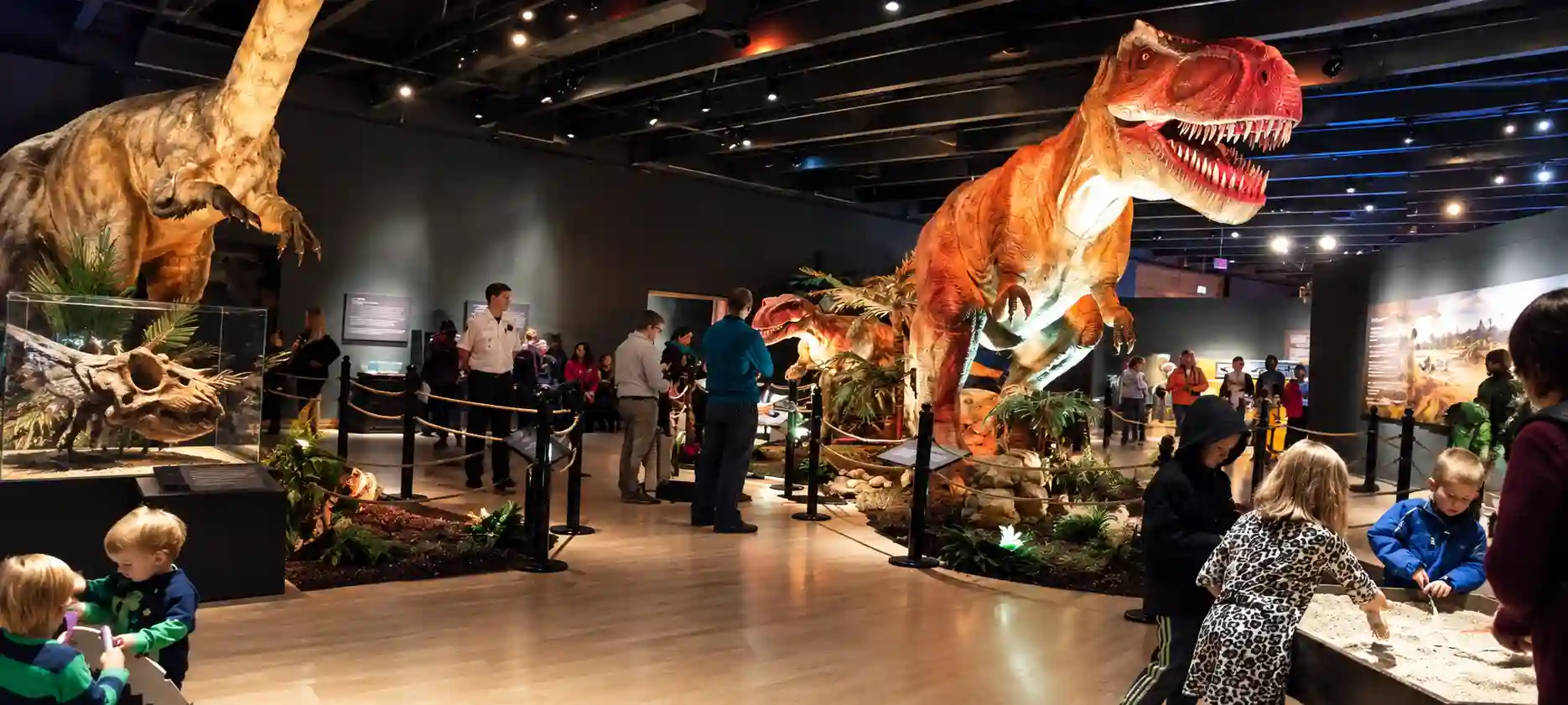
How Museums Use Animatronics to Create Interactive Exhibitions
Walk through a natural history museum, and you will see the standard layout: fossils behind glass, skeletons mounted on steel frames, and interpretation panels filled with dense text. These elements do the heavy lifting. They provide the scientific evidence, establish the facts, and communicate the research.
But there is a limitation.
A visitor can look at a dinosaur skull and understand it is large. They can read a panel stating the animal weighed several tons. Yet, something remains abstract. The scale doesn’t quite feel real. The behavior stays theoretical. The living animal—its actual presence in a landscape—gets lost behind the static specimen.
This is where animatronics enter the conversation. They are not here to act as entertainment or to substitute for authentic collections. Instead, they serve as a physical bridge between scientific evidence and visitor understanding. When integrated thoughtfully into an animatronic museum exhibition, these dynamic figures make abstract concepts observable. They give visitors a different way to engage with the subject matter, beyond just reading and looking.
For museum teams, the core question is rarely about simply adding technology. It is about determining whether movement can communicate something that static interpretation simply cannot.
Why Museums Are Using Animatronics in Interactive Exhibits
Making Scale Tangible
Fossils and skeletons are essential, but they have limitations. A mounted skeleton gives you the anatomy, but it struggles to convey what it actually felt like to share a landscape with a creature of that size.
Stand next to a mounted Triceratops skeleton, and you get one sense of scale. Watch a life-size figure move through a reconstructed habitat, and the perspective shifts. You get a physical, immediate understanding of the animal’s presence. For prehistoric exhibitions, this is critical. Reading “12 meters long” on a panel is one thing; seeing that length unfold in three dimensions creates a completely different level of comprehension.
Demonstrating Movement and Behavior
Static specimens cannot directly show how an animal moved or behaved. A Tyrannosaurus skeleton reveals teeth, bone structure, and approximate posture, but it remains silent on how the animal navigated its environment, fed, or interacted with others.
Museum animatronics fill this specific gap. The goal is not to replace scientific accuracy with Hollywood drama, but to make informed interpretations visible. When a figure demonstrates a specific feeding behavior or territorial display, it gives visitors something concrete to observe and question. The movement must communicate something specific, such as how the animal adapted to its environment, rather than just moving for the sake of motion.
Creating a Physical Point of Engagement
In a gallery filled with panels, cases, and mounted specimens, visitors need anchors. They need points where their attention naturally settles and curiosity spikes.
A well-placed figure serves this function perfectly. It becomes a visible, physical starting point for exploring the surrounding exhibit. Visitors gather, watch, and ask questions. From that initial engagement, they are much more likely to move outward into the surrounding interpretation, fossils, and educational content.
Making Complex Subjects Accessible
Museums serve audiences with vastly different backgrounds, learning styles, and levels of prior knowledge. Dynamic physical exhibits provide an alternative entry point into scientific information. A visitor who might walk right past a dense interpretation panel will often stop to watch a moving figure. Once they are stopped and curious, you have an opportunity to communicate.
An installation isn’t meant to replace the science. It simply provides a physical reference point, making dense scientific concepts much easier for a general audience to grasp and discuss.
The Four Roles of Animatronics in an Animatronic Museum
Not every animatronic exhibit contributes to an installation in the same way. In a professional setting, its value depends entirely on the educational and interpretive role it is designed to serve. We generally see museum animatronics fulfilling four distinct roles:
- Represent: Conveying scale and physical presence in ways that fossils and skeletons cannot fully achieve.
- Demonstrate: Showing movement and behavior based on current scientific evidence.
- Connect: Linking reconstructed animals back to the actual fossils, skeletons, and interpretation panels nearby.
- Engage: Creating a natural entry point for further visitor exploration and learning.
When an installation fulfills these roles effectively, it stops being a standalone attraction and becomes a functional part of an integrated interpretation system.
Animatronics Should Complement, Not Replace Museum Collections
A strong museum exhibition does not force a choice between authentic collections and dynamic exhibits. The most effective installations use both, with each element serving a distinct, non-overlapping role.
| Exhibition Element | Main Role |
|---|---|
| Fossils | Scientific evidence |
| Skeletons | Anatomy and structure |
| Replicas | Physical interpretation |
| Animatronics | Movement, scale, and behavior |
| Interpretation panels | Context and explanation |
| Interactive activities | Participation and exploration |
Fossils Provide the Evidence
Authentic specimens and scientifically produced replicas establish the evidence base. They are the foundation. Everything else in the exhibition derives its authority from that foundation.
For institutions working with fossil collections or planning exhibitions around paleontological content, understanding the role of dinosaur fossil replicas in establishing scientific credibility is essential. High-quality replicas allow museums to display complete specimens, protect fragile originals, and create hands-on learning opportunities without risking irreplaceable materials.
Animatronics Add Movement and Context
This is where the elements work together. Fossils provide evidence that the animal existed. Skeletons reveal its anatomical structure. A dynamic figure can then provide an evidence-informed interpretation of how it may have moved and behaved.
These statements do not contradict each other; they build on one another. Leading institutions already use this combination in practice. The [Smithsonian National Museum of Natural History] integrates life-sized reconstructions with fossil evidence to help visitors understand prehistoric life in tangible ways. Similarly, the New York State Museum’s Expedition Dinosaur: Rise of the Mammals combines life-sized figures with fossils, immersive environments, and interactive learning elements. In both cases, the moving figures do not replace the fossils—they help visitors understand what the fossils represent.
The Best Exhibitions Connect the Elements
Consider a typical visitor sequence: a visitor sees a fossil, observes a reconstructed skeleton, watches a demonstration, and finally reads interpretation about the behavior and environment.
Each step builds on the previous one. The visitor moves from “I see the remains” to “I understand the animal.” That progression requires intentional design, but when it works, the dynamic element becomes a seamless part of the learning system.

How Animatronics Support Museum Education
The educational value of museum animatronics is not incidental; it is the primary objective.
Turning Abstract Information Into Observable Experience
Interpretation panels might state: “This species was adapted for a particular environment.” That is accurate and important, but it is abstract. A figure that demonstrates particular postures or feeding behaviors makes that adaptation observable. Visitors can see what “adapted” actually means in physical terms, and then the interpretation panel explains why those adaptations evolved. Observation comes first, making the subsequent explanation meaningful.
Connecting Movement With Scientific Interpretation
It is crucial to be clear about what a dynamic figure is. It is not the knowledge itself. It is a physical representation that helps visitors engage with that knowledge. Movement triggers questions, and interpretation provides the answers. The figure facilitates those first steps by creating the movement that sparks curiosity.
Supporting Different Learning Styles
Visual learners benefit from seeing behavior demonstrated rather than just described. Younger visitors engage more readily with physical, dynamic exhibits than with text-heavy panels. Family groups find natural discussion points around observable phenomena, and school groups can connect what they are seeing directly to curriculum concepts about adaptation and behavior. This provides multiple pathways into the same scientific information.

Where Animatronics Can Add Value in Museum Exhibitions
Certain exhibition contexts make museum animatronics particularly effective.
Prehistoric Habitat Reconstructions
When building a reconstructed environment, such as a Cretaceous forest or a Pleistocene grassland, dynamic figures help make that space feel inhabited rather than just decorated. Adding movement and animal presence to the surrounding landscape creates a much more complete sense of place.
Behavior Demonstrations
Some concepts are simply difficult to communicate with static displays alone. Feeding strategies, territorial behavior, locomotion patterns, and parental care are all behaviors that animatronic exhibits can demonstrate in ways that make them observable and discussable.
Focal Educational Displays
A large figure can serve as a visual anchor for an entire exhibition zone. However, the focal point should lead visitors into the story rather than become the entire story. Its job is to draw people in, then connect them to the surrounding content.
Family and School Learning Areas
In dedicated education spaces, these installations can support observation, explanation, and activity in combination. They give school groups something concrete to observe before moving into hands-on activities or facilitated discussion.
When Animatronics May Not Be the Right Choice
Not every exhibition needs dynamic figures. The question is not whether an institution should use them, but where movement adds genuine interpretive value.
These installations may not be appropriate when:
- The scientific objective is specifically to display authentic specimens.
- Visitors need to observe fine anatomical details without visual distraction.
- The budget must be prioritized for collection conservation or core interpretation.
- A static model or skeleton can communicate the concept equally well.
Understanding where animatronic exhibits add value—and where they do not—is essential for effective exhibition planning.
How Animatronics Fit Into Interactive Museum Exhibits
Interactive museum exhibits can take many forms. Screens, digital interfaces, AR, and VR are common approaches, but interaction can also involve physical objects, observation, guided activities, and other forms of visitor participation.
What makes an exhibition truly interactive is ultimately the quality of the visitor’s engagement with the subject matter, whether that engagement happens through technology, physical participation, observation, or guided exploration.
Animatronics as Part of an Interactive Experience
It is useful to distinguish between two types of interaction:
- Interactive through participation: Touch screens, hands-on exhibits, and activities where visitors physically manipulate something.
- Interactive through observation: Exhibits where visitors engage by watching, questioning, and connecting what they see to interpretation.
Dynamic figures can contribute to an interactive museum exhibit, even when visitors are not directly controlling the figure. They create observable phenomena that trigger questions and discussion.
Combining Animatronics With Other Exhibit Elements
The most successful animatronic exhibits layer different types of interaction. A figure demonstrates behavior, the visitor observes the movement, an interpretation panel explains the scientific context, and a hands-on activity allows for further exploration. Each element serves a different function, deepening understanding through varied participation.
Designing the Visitor Learning Experience
The figure itself is just one component. The actual learning experience happens in the sequence around it.
- Attention: The figure creates an initial point of interest. Visitors stop and look, settling their attention on something specific.
- Observation: Visitors watch the movement, posture, and behavior. They notice details and form questions about what they are seeing.
- Interpretation: Now visitors are ready for scientific context. The interpretation panel, audio guide, or educator’s explanation provides the framework for understanding what they have observed.
- Exploration: With that understanding, visitors continue through the exhibition, connecting what they have learned to fossils, graphics, and related exhibits.
This sequence—Attention, Observation, Interpretation, Exploration—requires intentional design. When it works, the dynamic element becomes a catalyst for learning rather than just a display.
What Museum Teams Should Define Before Commissioning
Before commissioning animatronic exhibits, museum teams should clarify several foundational questions:
- What should visitors learn? Be specific about educational objectives.
- What behavior or concept should the exhibit demonstrate? The figure must serve a clear interpretive purpose.
- How does it connect with existing collections? The relationship to authentic materials should be explicit.
- Who is the primary audience? Children, families, school groups, and general visitors all have different needs.
- What role will interpretation play? The figure creates opportunities for interpretation; it does not replace it.
- Is movement necessary to communicate the idea? Sometimes a static replica or skeleton serves the objective better.
These questions should be answered before any decisions are made about creature selection, scale, or technical configuration. The educational strategy must drive the design, not the other way around.
From Concept to Museum-Ready Exhibit
For institutions considering dynamic figures, the real challenge is translating an educational objective into a physical exhibit that can operate reliably within a wider exhibition system. Integrating figures into interactive museum exhibits requires more than just selecting a creature. It involves defining the educational goal, determining the appropriate scale and behavior, engineering the mechanical and motion systems, specifying materials for the operating environment, integrating the exhibit with surrounding interpretation, and planning for installation and long-term operation.
The success of interactive museum exhibits ultimately depends on this seamless integration. If you are planning an animatronic museum project and evaluating where dynamic figures could add genuine interpretive value, Our museum experience systems can help you assess the concept, define the engineering requirements, and deliver a museum-ready exhibit that functions seamlessly as part of your broader exhibition system.
If you have any questions about integrating animatronics into your exhibition, please feel free to contact us.


