Tell Us About Your Project

Dinosaur Puppets for Museums, Schools & Theme Parks: 5 Proven Applications + Buyer’s Guide
Static displays get ignored. Wearable costumes are a logistical nightmare. That’s exactly why professional animatronic dinosaur puppets have become the secret weapon for venues needing real visitor engagement.
Operators hold them from the outside, which means no costume wear time. Visibility is fully open, helping a lot in crowded events.
Running a museum, school, or mall? Here are five proven ways to use dinosaur puppets, plus the real-world buying mistakes you need to dodge.
1. Museum Education Programs: Bringing Paleontology to Life
Static skeletons teach anatomy, but they don’t move. A realistic dinosaur puppet bridges the gap between fossils and living creatures, a strategy proven to boost learning retention according to the Association of Science-Technology Centers.
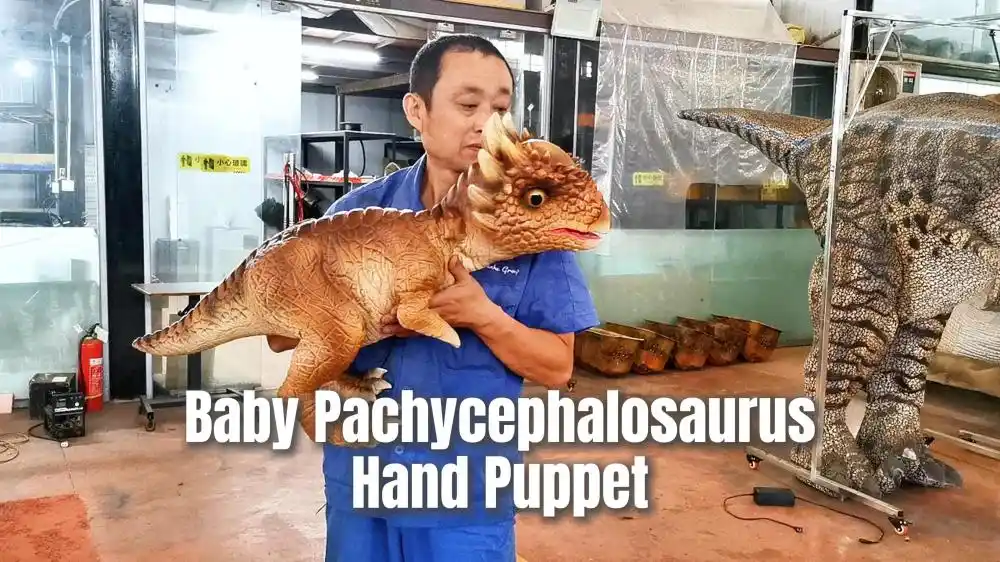
We usually see museums creating a “Meet the Dino” session. The educator holds a medium-sized puppet, making it react to the kids with blinking, head turns, or soft vocalizations. It turns a passive lecture into a dynamic chat.
From our production floor: Museums usually prefer 80-100cm medium puppets. They look impressive up close but are light enough for educators to hold for a 20-minute session without needing a heavy-duty stand.
2. School Outreach & STEM Events: The Ultimate Classroom Hook
Mobile educators need portability. It must fit in a car, set up in seconds, and grab the attention of 30 energetic students.
A lightweight dinosaur hand puppet works best here. Teachers use it for storytelling or predator-prey demos while managing the class with their free hand. We strongly push dinosaur puppets for schools because a single teacher can toss one in a tote bag and drive to the next class. A 10kg medium puppet, on the other hand, usually requires two people to transport and operate safely.
3. Shopping Mall Promotions: Creating Viral Photo Moments
Malls need family attractions that drive foot traffic. A massive, lifelike creature is a natural crowd-puller.
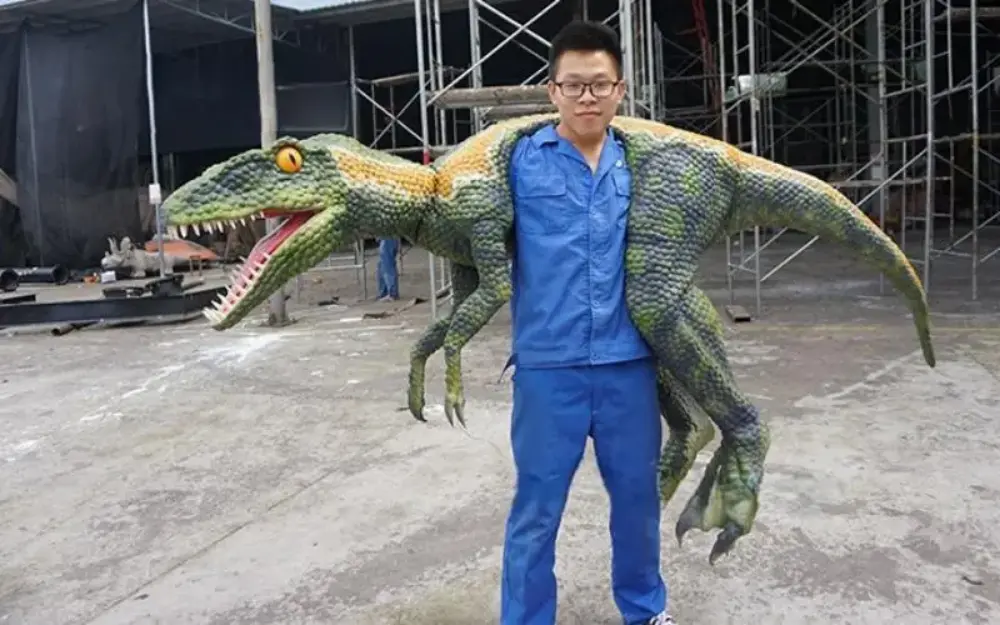
Deploy a large dinosaur puppet during holiday weekends. The operator roams the atrium, posing for photos. Since the operator is outside the suit, they can safely guide kids in for close-ups without bumping them.
Logistics Note: For large shoulder puppets, we usually advise clients to reserve 20-30cm of extra space in custom flight cases for shock-absorbing foam. Mall floors often have uneven tile transitions, and the extra padding saves the internal frame from stress during transport.
4. Theme Parks & Zoos: Enhancing Walk-Around Experiences
Parks need characters to activate dead zones. But the physical toll of heavy costumes limits floor time.
Many venues deploy dinosaur puppets for short for short, high-impact pop-up encounters. A performer carries a large puppet for a loop, then hands it to a colleague or parks it on a wheeled base. In continuous roaming, we typically recommend rotating operators every 15–20 minutes for puppets over 15kg. Past that window, shoulder fatigue noticeably kills the movement fluidity, and the illusion breaks for the audience.
5. Interactive Theater & Storytelling: Immersive Audience Participation
Small theaters and festivals use puppets to captivate audiences. Animatronics take this to the next level.
Make the animatronic dinosaur puppet a character in the live show. Subtle movements—a twitching tail, a blinking eye—add realism fabric puppets can’t match. The narrator gets a reactive co-star. Under harsh spotlights, we often customize the silicone skin with matte finishes to prevent unnatural plastic reflections. Standard retail puppets usually miss this detail.
Common Buying Mistakes (and How to Avoid Them)
Knowing where to use a puppet is half the battle. Buyers often overlook operational realities. Several of these issues only become obvious after the first few weeks of operation, which is why they’re frequently missed during procurement. Here are the most common traps we see, and how to avoid them.
Mistake 1: Ignoring the “Last Mile” Transport
Buying a large puppet without checking if it fits your cargo van. Always get the exact packed flight case dimensions. For medium puppets, ensure the case fits through standard double doors. For large ones, ask if the tail or head detaches to save shipping volume.
Mistake 2: Underestimating Operator Fatigue
Expecting one person to carry a 20kg shoulder puppet for a 2-hour shift. Plan mandatory 10-minute cool-down breaks. For large puppets, use a two-person team: a Puppeteer on the remote, and a Handler for lifting and crowd control. Also, ask your supplier to reinforce the jaw hinge and neck joint. Those are the first areas needing inspection after months of heavy use.
Mistake 3: Skipping the “Touch Test” for Materials
Buying dinosaur puppets with hard, glossy silicone for a kindergarten. Match the material to the audience. Schools and young kids need soft-touch, washable fabrics or flexible silicone-coated foam. Outdoor mall events? Insist on high-grade, tear-resistant Shore A 40-50 silicone to survive daily grabbing.
Mistake 4: Overlooking Setup and Teardown Time
Assuming all animatronic dinosaur puppets are plug and play. Ask about the control system. Wireless remotes must sync in under 30 seconds. If a puppet needs complex cable management or 15 minutes of calibration before every show, it will kill your operational efficiency.
Ready to Bring Your Next Event to Life?
A professional dinosaur puppet is an engagement engine. Boost museum attendance, make STEM classes unforgettable, or create a viral mall activation.
If you’re not sure which type fits your venue’s constraints, just drop us a line. Send over your floor plan, event schedule, or transportation limits, and we’ll recommend the exact size and configuration that works for your team.